Major Arcana Tarot Cards, if they were Jane Austen characters.

Greetings, gentle reader. In these dark times (* gestures toward…everything), we could all use a little fun. So if you, like me, enjoy Jane Austen’s novels and if you, like me, also enjoy using Tarot as a storytelling tool, then may I present: the Major Arcana tarot cards, except all of them are characters from Jane Austen novels.

[DISCLAIMER: Spoilers for 200-year-old novels below. Also, the beauty of both tarot AND Jane Austen characters lies in the rich variety of interpretations inspired by each. There are a gazillion ways I could have cast this list. I welcome debate but not vitriol.]

(0) THE FOOL – CATHERINE MORELANd

The easiest card to assign! Young, good-natured, credulous Catherine Moreland of Northanger Abbey embodies The Fool’s optimism and willingness to dream without reservation. She may learn some unpleasant truths about the ways of the world throughout the novel (after all, she has no little dog nipping at her heels to remind her about that sharp cliff at her feet), but at the novel’s end her kindness and sweet nature remain intact. Catherine generally believes the best of people, and of life itself.

(1) THE MAGICIAN – ELINOR DASHWOOD

Am I biased because Elinor Dashwood of Sense and Sensibility is my favorite Austen heroine? Certainly. But Elinor is a woman of many talents, with the drive to practice and refine them. No matter what life throws her way, she gets shit done. Need to build a budget for your dramatically reduced household income? Elinor’s got it covered. Need a skillful work of art? Elinor can paint one for you. Need to wrangle a collection of ladies who steadfastly refuse to hear reason? That’s Elinor’s main role in life. Need a ride-or-die defender to shield you from the man who ruined your life? Elinor. Need someone to make obligatory small talk with obnoxious relatives and friends, so that you don’t have to? Elinor’s got you. She gives the most Magician energy of all Austen’s heroines.

(2) THE HIGH PRIESTESS – lady catherine

Okay, but hear me out on this one. As a more intuitive version of The Hierophant’s reliance on rules and structures, The High Priestess knows that the way her intuition tells her things should be, reflects the way things actually should be. This way of looking at the world suits Lady Catherine de Bourgh, everyone’s favorite villain from Pride and Prejudice. You’ll note I haven’t said that Lady C’s understanding of rules and hierarchies is factually correct, simply that she considers them as such. From the raising of chickens to the shelving of cupboards to Pemberly’s pollution levels, Lady Catherine gives advice from on high and believes with all her soul that her gut feelings can stand as absolute truth.
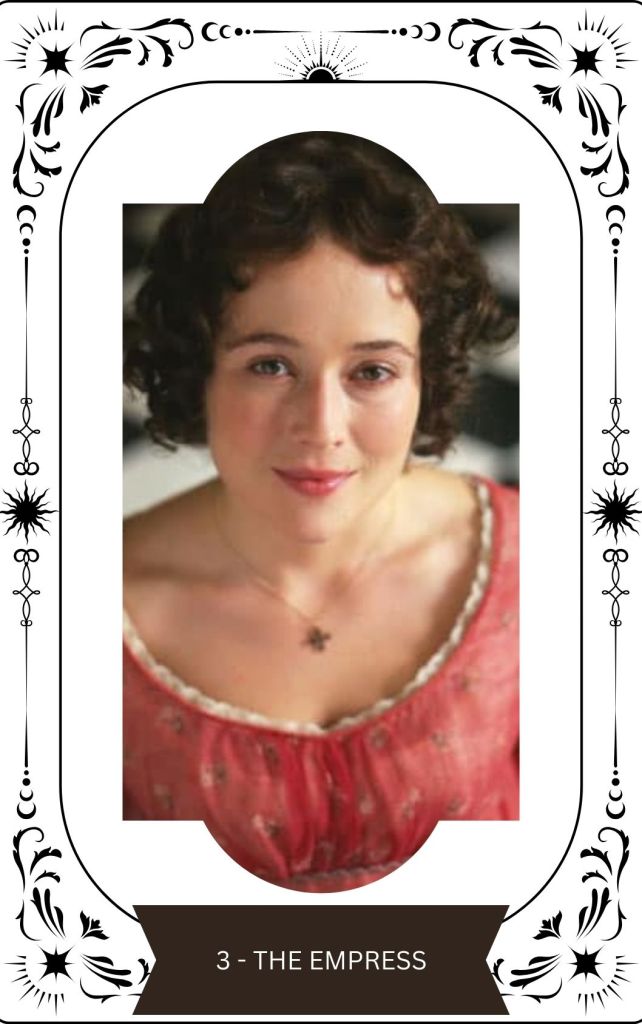
(3) The Empress – Elizabeth Bennet

Pride and Prejudice’s Elizabeth Bennet reigns as more than the Empress of our hearts, and more than Austen’s most famous heroine. She embodies the energy of The Empress card by embodying all of the best qualities in a heroine: warmth, courage, affection, dazzling intelligence, and a determination to defend and protect those whom she loves. Vanessa Zoltan and Lauren Sandler have called Pride and Prejudice the first female superhero story, and I agree – the scenes in which Lizzie Bennet fends off both Mr. Collins and (especially) Lady Catherine de Bourgh make us cheer for a reason.
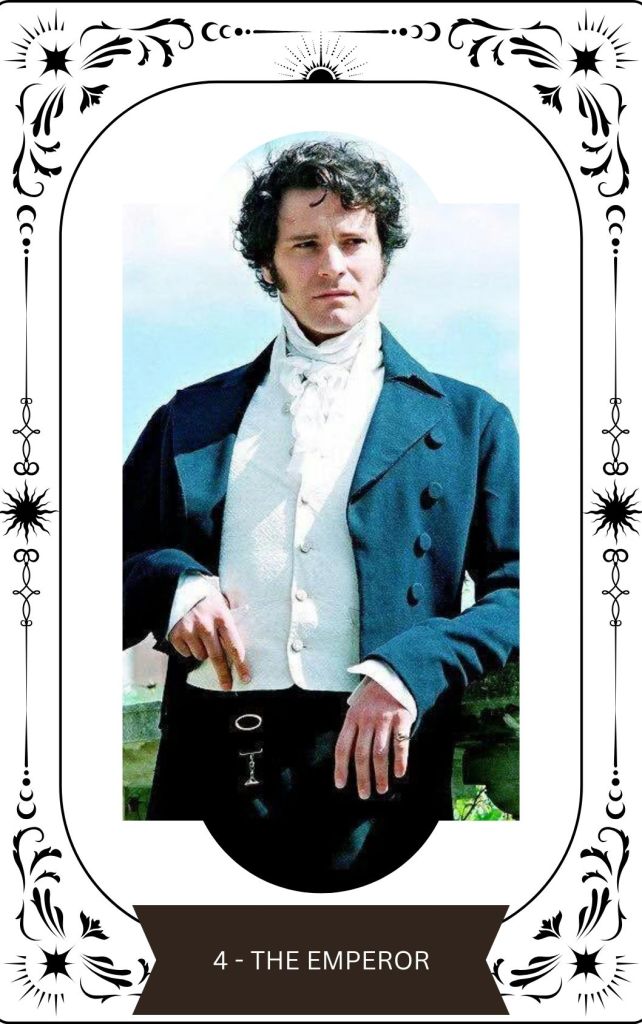
(4) The Emperor: Fitzwilliam Darcy

Obviously, right? Darcy not only exudes wealth and power, but his attractions for Elizabeth increase dramatically once she begins to learn just how competent he is at managing an entire county. Once she learns how caring and considerate a landlord Darcy has always tried to be, what a protective and affectionate brother he is, and what a tasteful homeowner he is? That’s super super sexy according to The Empress herself.

(5) The Hierophant – Edmund Bertram

Oh, our sweet and bland Edmund. I was determined that all of Austen’s leading men should appear on this list, and The Hierophant card’s energy feels most appropriate for Edmund. Clergyman Edmund possesses a warmth of affection for Fanny Price, but he also possesses a strict sense of propriety, of rules, of hierarchy, of responsibility, and of right and wrong. This quality makes it so frustrating (or, if you’re me, delightful) to read an entire novel in which he remains so deeply wrong about the woman on whom he crushes. The Hierophant can go one of two ways energetically: he can be a helpful guide and mentor, or he can be an annoying killjoy. For Fanny Price, Edmund gets to embody the first energy; for everyone else, the second.

(6) The Lovers: Anne Elliot and Frederick Wentworth

Look, I recognize that The Lovers will probably be the most contentious assignment of this entire post, and your mileage may vary. But when it comes to an immediate, consuming passion that transforms into long-term devotion, for which one is ultimately willing to sacrifice his pride and the other remains willing to sacrifice her lifestyle and place in society? After years? The honor goes to our favorite naval couple from Persuasion, at least for my money.

(7) The Chariot – Charlotte Lucas

The Chariot card is about seizing and/or maintaining control and momentum. Doubt her choice of life partner all you want, but Charlotte Lucas of Pride and Prejudice knows exactly what she wants, she makes a plan to get it, and she succeeds in her plan. Think of all of the variables she had to manage into smooth sailing: Mr. Collins’ wounded pride, Lizzie’s judgement, signing up for a life of feeling like second best and enduring a husband she cannot love. In today’s new age parlance, Charlotte Lucas manifests the hell out of her comfortable marriage and position with clear and determined eyes.
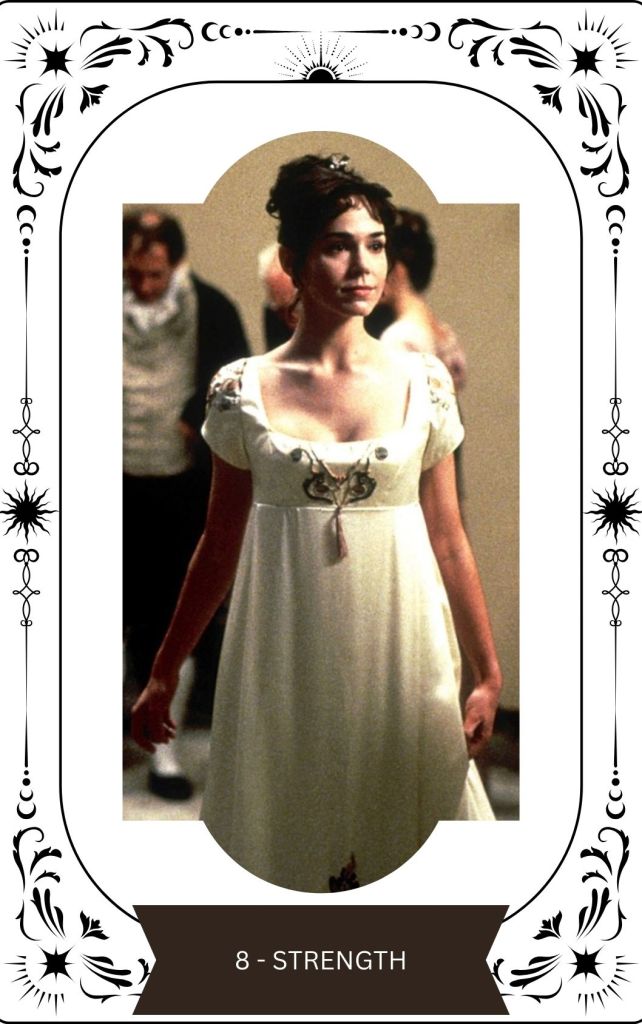
(8) Strength – Fanny Price

My choice in Mansfield Park’s Fanny Price may surprise those who simply view her as the most timid and milquetoast of all Austen’s heroines. But the Strength card relies less on outward courage and display of strength, and more on internal fortitude, which Fanny possesses in spades. I maintain my theory that when Austen sat down to write Mansfield Park, she sat down determined to write a heroine who is, among other distinctions, an introverted version of Elizabeth Bennet. Think about it: Fanny remains an observant and unerring judge of character, but rather than sharing her judgements as Lizzie does, Fanny keeps her observations to herself. As a young woman who starts her novel in the most disadvantaged position of all Austen’s heroines, Fanny has the farthest to rise in society and also the farthest to fall. Yet she remains steadfast in her adherence to right and wrong. She refuses to take part in the ill-fated Lover’s Vows production and steadfastly refuses to marry a man she cannot trust despite immense pressure (and eventual punishment) from her entire family, including her beloved and trusted Edmund. Even more impressive, she remains a kind and loving person after years of neglect from her family and years of outright abuse from Mrs. Norris. Now that is the Strength card personified.

(9) The Hermit – Anne Elliot

The Hermit card illustrates finding one’s truth in the quiet moments, and taking one’s own counsel. To me, Anne Elliot radiates that energy during the events of Persuasion. While she may have allowed Lady Russell to persuade her against her own inclinations and happiness as a teenager, nowadays Anne keeps no counsel but her own. Sometimes a hermit must wander off alone to explore her inner truth. Some hermits, like Anne Elliot, have mastered the art of wandering off alone for reflection even when surrounded by horrible other people. The more mature Anne Elliot of the novel thinks what she thinks and knows what she knows, whether she shares with others or not – and she’s almost always right.

(10) The Wheel of Fortune – Lucy Steele

Gotta hand it to Lucy Steele of Sense and Sensibility: the girl understands that life can throw curveballs, that fortunes come and fortunes go. This understanding makes up the essence of the Wheel of Fortune card. (A bit on the nose, Lucy literally rides a Wheel of Fortunes in the novel.) Whatever curveballs come, she will adjust and adapt, and do everything in her power to hold on to what’s hers and to what she believes she deserves in life.
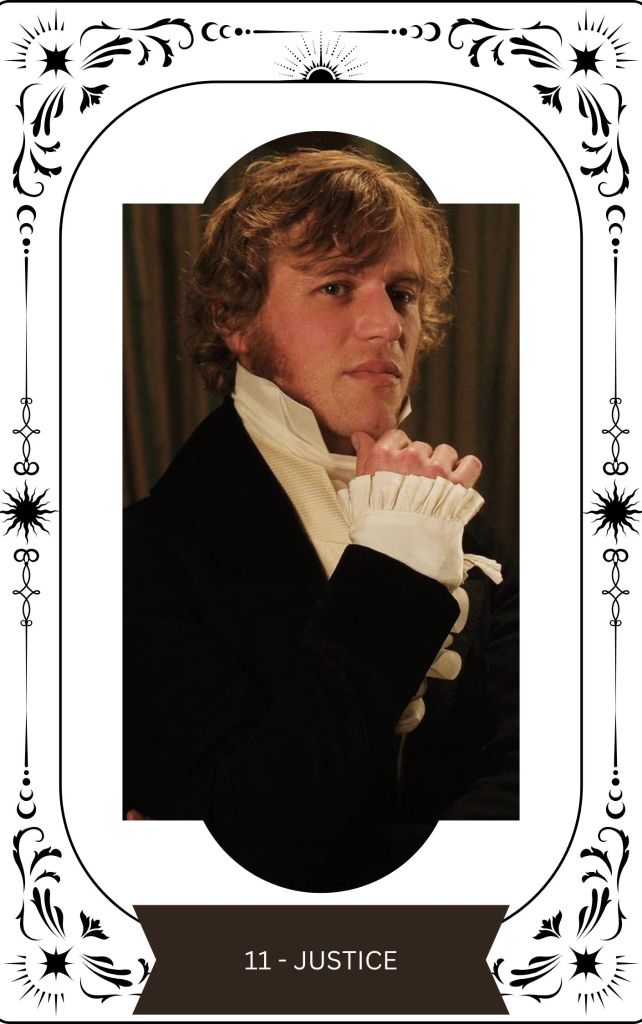
(11) Justice – George Knightley

Ah, finally we reach Mr. Knightley of Emma! Though perhaps not quite so impartial as he believes himself to be, at least not when it comes to a certain heroine, he is certainly the most levelheaded of the novel’s characters. Moreover, Mr. Knightley believes in fairness, in giving people credit where it’s due and calling out those whom he sees as unjust or dishonest (to witness: Mr. Elton, Frank Churchill, Emma, etc). He values Robert Martin’s inherent sense and goodness, and treats Harriet with kindness, despite differences in rank. He can’t stand to see a marginalized character like Miss Bates abused, however jokingly, by those of higher status. The Justice card suggests a call toward fairness and balance, and Mr. Knightley brings both to his respective Austen novel.
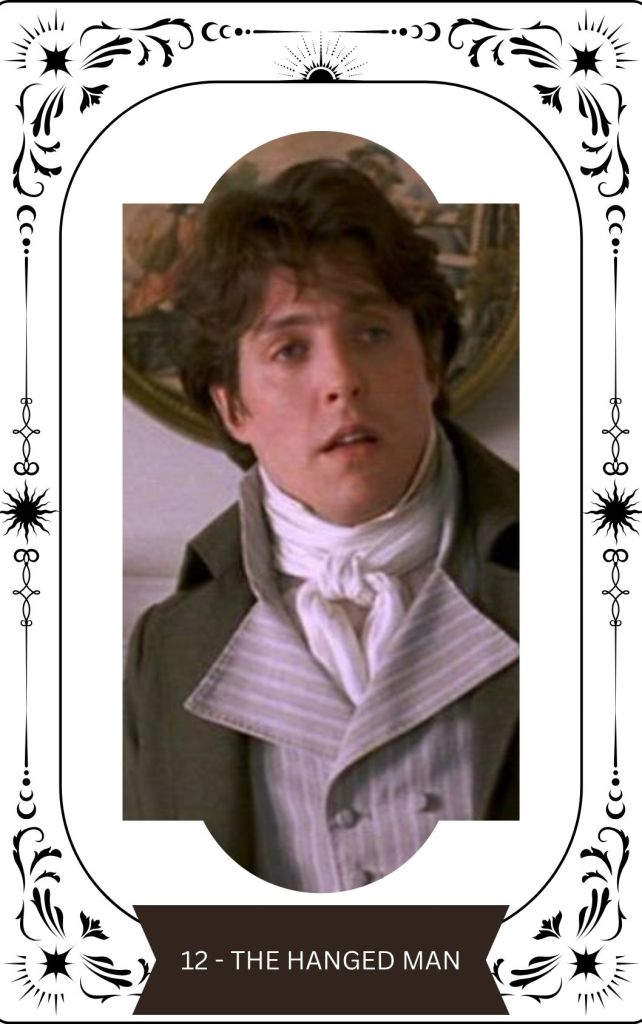
(12) The Hanged Man – Edward Ferrars

Sometimes you find yourself stuck in a situation, knowing that you’ve made your decisions and done all that you can without sacrificing your honor. Both the outcome and its timing now lie beyond your control – you have to ride it out and see what happens, like poor Edward in Sense and Sensibility. I’m not saying that Edward had zero responsibility for the awkward circumstances he now finds himself in…but I can’t help but pity him because they are extremely awkward. Even before the novel begins, Edward has already stranded himself in a life where he can only live in apprehension, waiting for the outcome of circumstances beyond his control. Once his secret engagement comes out into the open and he finds himself suddenly disowned, he must still live in apprehension about whether or not Lucy will set him free, how long it will take him to find a living as a clergyman, and so on. And while the engagement remains a secret, he has a chance to reconsider and revisit his circumstances through a different point of view – by comparing Lucy with Elinor. This opportunity for a change in viewpoint can also be suggested by The Hanged Man.
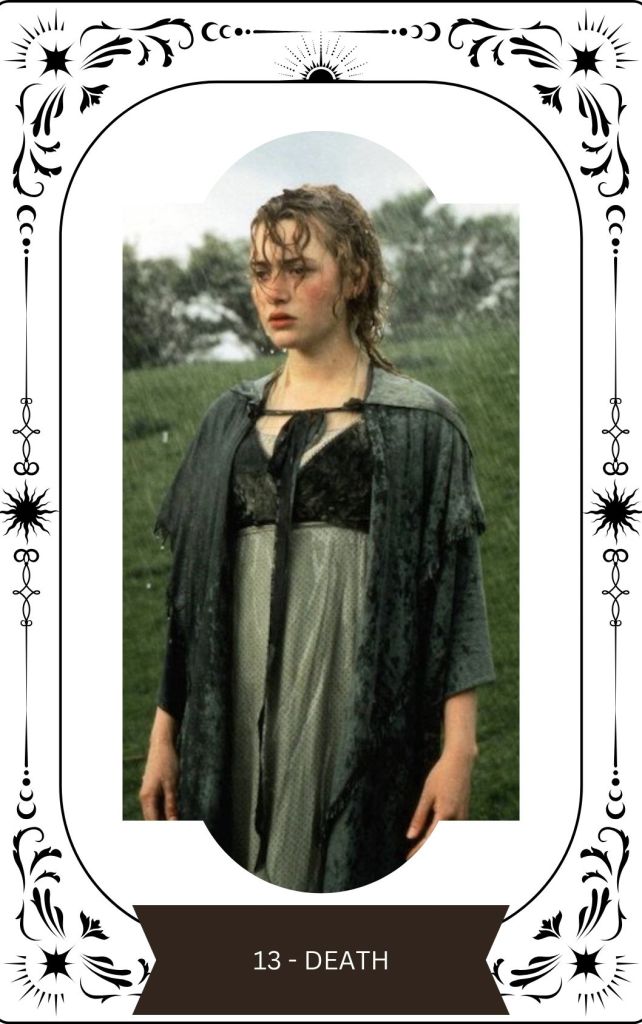
(13) Death – Marianne Dashwood

Famously the most misunderstood and misrepresented card in the deck, Death often refers less to physical death than to spiritual/mental rebirth: out with the old you, in with the new you and your new world. But Marianne Dashwood – the free-spirited, romantic, and impetuous younger heroine of Sense and Sensibility – has a story shaped by both types of death. Of all Jane Austen’s heroines, I find Marianne’s story to be the most drastic in its journey and character development. At the novel’s beginning, Marianne has constructed a very distinct identity and set of beliefs for herself, which she will relate to anyone who’ll listen (and even to those who won’t). By the end of the novel, the story and personality that Marianne prided herself on has come crashing down around her in the most painful and humiliating way – all that’s left to her is rebirth into a new, more composed, more mature version of herself. But Marianne’s journey is also shaped by two major encounters with physical death: her world changes dramatically for the first time following the death of her father, then once again after her own brush with death during her illness. She has not entirely changed as a character by the end – glimpses of the old Marianne still shine through – but her experiences have given her a new outlook on life.

(14) Temperance – Jane Bennet

Oh, sweet Jane. The Temperance card illustrates moderation and balance, and the oldest Bennet sister from Pride and Prejudice is nothing if not moderate and composed. (A little too composed when it comes to returning affection, it turns out. Charlotte Lucas isn’t wrong.) Her temperate energy reaches beyond her mild manner, however: during her discussions with the STRONGLY OPINIONATED Lizzie, Jane refuses to leap into anger or condemnation, always quick to remind Lizzie that explanations can and do exist somewhere between absolute villainy and absolute innocence. It’s easy to read Jane as a diffident foil for Lizzie, but read closely and you’ll realize that Jane more than holds her own against Lizzie when urging her to more moderate views. Lizzie might be more witty and irresistible, but Jane provides necessary temperance in their sisterhood and their family at large.
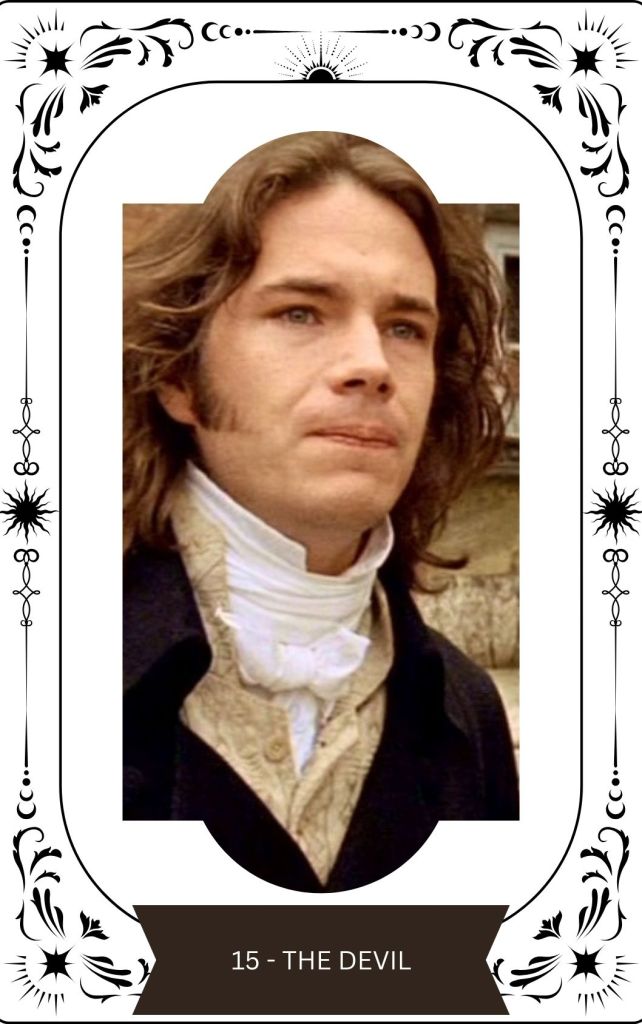
(15) The Devil – Tom Bertram

I tend to read this card not as representing an actual devil or similar villain, but rather representing a high-stakes struggle with temptation and vice. There were quite a few characters whom this card could fit (Wickham from Pride and Prejudice seems an obvious choice), but to me, Tom Bertram from Mansfield Park best represents the card’s element of struggle. From Chapter 3 onward, the eldest son of Lord Bertram exhibits a tendency toward alcoholism and other vicious pleasures which will hang over the rest of the novel like a cloud. His struggles materially impact not only himself but the rest of his family, particularly younger brother Edmund. Toward the end of the novel, they nearly cost him his life. Tom Bertram doesn’t seem like a bad person, but rather a careless person who tries and fails to wrestle with addictions starting at an early age.
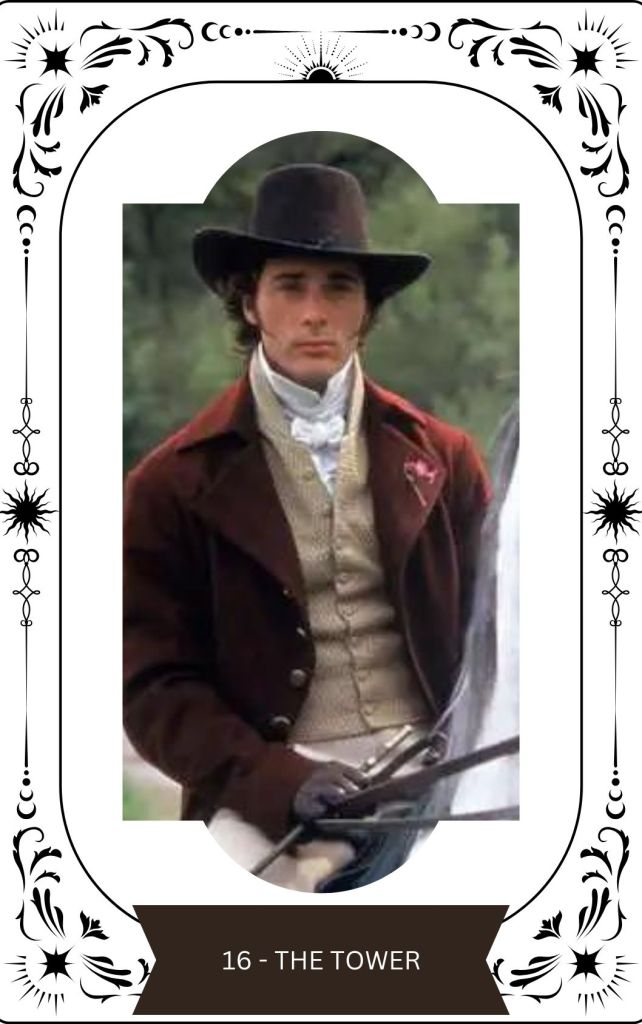
(16) The Tower – John Willoughby

We’re more than halfway through The Fool’s journey now, and now we come to the terrifying Tower card. Sometimes, a bolt of lightning will hit the world that you have carefully built for yourself and send it crashing down around you. Sometimes that bolt of lightning is charming and well-spoken and hot, and is named John Willoughby. Just as the Death and Tower cards connect in their representations of dramatic change – one metaphoric, one catastrophic – Marianne and Willoughby from Sense and Sensibility are similarly linked. Marianne’s “death” and rebirth into a mature young adult could never happen without the catastrophe that is Willoughby, and Willoughby could never be such a catastrophe if Marianne wasn’t so much in need of maturation. But unlike Marianne, who learns and grows from her experiences and mistakes, Willoughby is just that bolt of lightning. By the novel’s end, he remains as selfish and careless as ever. (At least to me. You can argue that Willoughby repents his actions a tiny bit, but Austen herself points out that he ain’t exactly leaving his rich new wife to go right his many wrongs.)

(17) The Star – Mrs. Smith

The Star is one of my favorite cards in the deck. After our long night, the gauntlet run from The Hanged Man through The Tower cards, finally we can see a small but glowing light above us. Hope is renewed for a better outcome than we could first see in the immediate aftermath of our crisis. To me, no character in Austen illustrates such resilience better than Mrs. Smith, Anne Elliot’s childhood friend in Persuasion. Mrs. Smith has fought quite the bout with Deaths and Devils and Towers: after becoming a destitute widow when her beloved husband died and left her with his debts, she finds her options further restricted by a debilitating chronic illness. Nevertheless, following a brief period of despair, Mrs. Smith has found a new purpose in life, a new reason to get out of bed: enjoying delicious gossip. She refuses to let her difficult circumstances defeat her, instead exercising what Austen calls “an elasticity of mind” to rally and to find hope and amusement in her altered existence.

(18) The Moon – Frank Churchill

What the hell is Frank Churchill’s deal, anyway? You never quite know where you stand with him, or what he’s after. The king of double meanings and innuendos and playing all sides, Frank feels a bit of a cipher throughout most of Emma. Even once his secret engagement to Jane Fairfax is revealed, I just…why all the elaborate scheming, my dude? Did all your misdirections need to be quite so complicated? Before we can get from the hope of The Star card to the glory of The Sun card, first we must wade through the murky Moon card, which represents shifting sands, potential lies, and uncertainty. That pretty much sums up Frank Churchill.

(19) The Sun – Emma Woodhouse

For everyone who’s spent much of this list yelling “OKAY BUT WHERE IS EMMA?!” at me: here she appears, at long last! Finding a Major Arcana card for Miss Handsome, Clever, and Rich felt like an enormous challenge, but ultimately I feel that Emma embodies the most positive aspects of the Sun card. Sparkling presence, genuine and loving warmth, wealth and power and abundance – Emma carries all of these energies. And with the Justice-minded Mr. Knightley at her side making sure that she uses her powers for good, she simply shines all the brighter. We are happy, because she ends the novel genuinely happy.

(20) Judgement – Henry Tilney

We began our journey with Catherine Moreland as The Fool, and now we return to Northanger Abbey to finish the journey with Henry Tilney. I enjoy reading the Judgement card less as a monotheistic-Judgement-Day kind of judgement, and more as an internal calling: are you living as your best self? What do you feel called to do? My personal favorite romantic pair in all of Austen’s work, Henry and Catherine compliment one another by each inspiring a wake-up call within the other (much like that equally-excellent pairing, Lizzie Bennet and Mr. Darcy). When Henry quite literally judges Catherine for her flights of fancy and their potential harm, she feels called to acknowledge the wide gulf between imagination and real life going forward. When Henry, in his turn, learns how cruelly his father has treated Catherine, he feels called to stand up to his father by declaring his growing attachment to her. He immediately rushes to Catherine’s faraway home to offer her his hand in marriage. Happy sigh.

(21) The World – Col. Christopher Brandon

We made it! The World card represents the end of The Fool’s hopeful journey – or the end of this current journey, at least. The idea is to find completion in this round of personal growth, so that we can embark on a new journey equipped with all the life experience and self-knowledge we’ve recently gained. Colonel Brandon embodies so many facets of the World card. He has largely completed a Fool’s journey already (minus some lingering heartbreak) before Sense and Sensibility even begins, and he ends the novel ready to start a new phase of life, a new journey. Better still, he offers Marianne a chance to do the same, to enter a new phase of personal growth and a new chapter of her own life. The World can be read as a card of reward, and to me at least, Brandon is Marianne’s reward for the hard luck and humiliation that she has survived. I know there are plenty who disagree with me, who feel that Marianne is conversely used as a reward for Brandon’s friendship in a time of crisis. (And I can understand that point of view, especially since Austen herself writes the words “Marianne was to be the reward of all,” uggggh.) But Marianne also needs a new purpose in life, a new animating force, and I believe that she finds a loving and appropriate one in marrying Colonel Brandon – by allowing him to give her the world, har har. Brandon is a truly worldly character.

So, what do you think of our journey through the Major Arcana, reader? (Let us pretend we took said journey in a barouche.) How would you assign characters in your own deck?

Castlerigg Circle *

Castelrigg Stone Circle, UK

*Please remember that I make no pretensions to being a poet. Rather, I am a writer who occasionally writes in impressionist prose.

CASTLERIGG CIRCLE

I’ve been here before

on that one trip. 

Twelve years old. My mother,

excited for my uncle to drive us

to these stones.

My uncle, bemused. 

Myself, carsick. 

My mother, aglow. 

I can’t remember

if it was sunny or gray

I can’t remember

what I said, what I felt beyond

Why are we here? 

“Why did we drive all this way for rocks?”

“They’re special rocks.” 

“They look like regular rocks.” 

“They’re like Stonehenge.”

“But this isn’t Stonehenge, these are just rocks.” 

“Do you have any idea how old these are, or 

How long they’ve stood here?”

No, I didn’t, because I was twelve. 

And no, I still don’t

Because I’m nearly forty

Nearly the age she was

and just as incapable of comprehending

Age, and The Ages. 

Prehistoric, a word, what does that mean? 

Describe it for me in words

That YOU can understand. 

These rocks look good after

A thousand years. Were they

sharper in the beginning, 

rough-hewn? Were they 

taller? 

We don’t know if ancient peoples

of Cumbria used this stone

beneath my hand

for trade or events or religious

sacrifice. We don’t know. 

I don’t know. 

I don’t know if my mother

told me this. 

I don’t remember how long we

stayed. I wish I remembered. 

I wish I’d listened. 

I wish I’d appreciated my

Grandfather leading me to

his mother’s grave, and not

wished instead to go shopping. 

I’m sorry, my family, 

my long maternal line. 

I’m sorry but I am 

here now and I 

wish you could be 

too. 

I want to come back here with my 

Mother now that I 

am nearly forty, and 

we could appreciate the passage of 

TIME

of which we had too little

and she will never walk 

through these stones again, but

if I place my hand on 

this large stone

right here – with the peaks as witness – 

perhaps I can feel the atoms

of eleven generations 

of Shaws dissolved into the 

Northern soil.

A poem? A poetic essay? A jumbled assemblage of sentences? Who knows.

SANDBURG GIRLS

o the girl sledding down the giant hill: everything turns out okay.

To the girl who discovers the hornets’ nest: everything turns out okay.

To the girl who throws a ring into the lake: everything turns out okay.

To the girl who creates “secret” paths: everything turns out okay.

To the girl who goes for daily hikes in hopes that he might show up: everything turns out okay.

To the girl having her hair nibbled by a baby goat: everything turns out okay.

To the girl taking (trespassing) snow hikes with her parents: everything turns out okay.

To the girl who loves the maple at the first bench: everything turns out okay.

To the girl who needs to out-walk her fear of her mother’s unbearable sickness: everything turns out okay.

To the girl who encounters a grown bear with no one else around: everything turns out okay.

To the girl who, mortified, asks a new friend to prom approximately five minutes before he was planning to ask her: everything turns out okay.

To the girl carrying her history textbook up the mountain to make homework bearable: everything turns out okay.

To the girl watching her mother carry their injured dog down a snowy mountain: everything turns out okay.

To the girl recovering from surgery, who measures success in laps around the lake: everything turns out okay.

To the girl who, mad with grief, climbs her maple out over the water to tear off the dead tree limbs weighing it down: everything turns out okay.

To the girl whose terrifying love for him feels like bright light and sound and rage and song and threatens to rip her to pieces: everything turns out okay.

To the girl who loves night hikes with her mother: everything turns out okay.

To the girl who no longer recognizes her father: everything turns out okay.

To the girl convincing her fiancee to propose again, this time on a specific lake bench: everything turns out okay.

To the girl watching a dark field of fireflies with a kindred spirit: everything turns out okay.

To the girl on a college planning walk with her father: everything turns out okay.

To the girl who feels alone, even with friends: everything turns out okay.

To the girl who reluctantly continues up the path at her mother’s request, when her mother feels too weak to continue: everything turns out okay.

To the girl who remembers when those trees were small enough to still see the distant mountains behind: everything turns out okay.

To the girl who just needs to get away from her parents: everything turns out okay.

To the girl scaling a vertical rock as her father yells at her to come down: everything turns out okay.

To the girl discovering a secret overgrown garden: everything turns out okay.

To the girl talking to herself as she writes songs and poems and plays and everything in between: everything turns out okay.

To the girl exposing her heart to a longtime crush, then having it rejected: everything turns out okay.

To the girl who never suggests anywhere else to meet up with friends: everything turns out okay.

To the girl who wants to claw the memories out of her skull: everything turns out okay.

To the girl on the greenhouse roof, dreaming with a kindred spirit: everything turns out okay.

To the girl who fears no one will ever truly choose her: everything turns out okay.

To the girl who waits at the wishing pond, watching for a green truck: everything turns out okay.

To the girl petting goats with her husband: everything turns out okay.

To the girl on her favorite bench, longing to just lie down and give up: everything turns out okay.

To the girl who wonders if she’ll ever stop missing him: everything turns out okay.

To the girl enjoying a family picnic by the old bridge: everything turns out okay.

To the girl who expects ghosts around every tree, and one day the ghost is flesh and blood: everything turns out okay.

To the woman who mourns the lake because can’t ONE thing stay the same: everything turns out okay.

To the woman and girls who cried and cried and

Worried and

Worried and

Worried:

Everything turns out okay.

Hey, Austen Fans: I Read UDOLPHO so You Don’t Have To

[Oh my, look who’s posting for the first time in ages and ages! It me. That light at the end of the grad school tunnel finally approaches…]

It is a truth universally acknowledged that most Austen fans who read Northanger Abbey and wonder “What the heck is this Udolpho everyone keeps mentioning,” must subsequently find themselves running far from Anne Radcliffe’s The Mysteries of Udolpho as soon as they see it. Clocking in at 632 pages – and that’s with teeny tiny Penguin Classics type, mind you – Udolpho is a gothic monster most folks don’t mind skipping. Especially once they try to struggle through the first chapter or two. 

Well, reader, Northanger Abbey has always been my favorite Austen novel and I finally decided to brave the monster myself. And here’s the thing: it’s not bad. It’s not exactly what modern readers would consider good, either, since editors have a lot more control these days – but once it got going I felt sucked in to the trashy fun, same as Austen and her family did a few years after its release. The fun is just wrapped in a whole lot of Romanticism and tiresome moralizing and endless nature writing. 

Here are some thoughts in case you want to know the ways that Anne Radcliffe’s 1794 blockbuster influenced not only Jane Austen’s earliest (but last published) novel Northanger Abbey, but also Jane Austen’s writing style itself. 

But first! Click here for a brief-as-possible plot synopsis of The Mysteries of Udolpho (just kidding, this book is LONG.)

Emily, a virtuous young maiden growing up in the French countryside under the tutelage of her equally virtuous and conveniently wealthy father, enjoys the sublimity of the surrounding nature A LOT. Then her als0-virtuous mother dies. To rally her father’s spirits, Emily takes him on a tour across rural France, and they marvel over the sublimity of natfure A LOT. One night they meet a wanderer named Valancourt, to whom both Dad an Emily take an immediately liking because he is likewise pure and virtuous because “he has never seen Paris.” They all enjoy the sublimity of nature A LOT. When they shelter near a mysterious castle (or chateau? whatever), Dad acts super cagey about his relationship to the castle and a woman who lived there long ago, then he promptly succumbs to illness and dies. Emily returns home, now under guardianship of an Aunt she’s never met. 

Got all that? Good. 100 pages down. 

Turns out Emily’s aunt is an awful person. She dithers on whether or not Emily should encourage Valancourt’s affections, finally setting up an engagement when she learns he’s from a wealthy family, because of course he is. Emily and Valancourt are very much in love and thrilled to get married except OOPS, Awful Aunt finds Even More Awful Italian Guy named Montoni, who talks her into marrying him, and Montoni immediately calls off Emily’s upcoming wedding. Valancourt is PISSED, but what can he do? Montoni also decides to whisk his new wife and “niece” off to Italy with zero warning, which is not a sketchy thing to do at all. 

They get to Italy, where Emily appreciates the sublimity of nature A LOT. She is pursued by one Count Morano, whom she continually rebuffs, and Montoni forces her to marry the Count until OOPS he mysteriously whisks her and her aunt of to the remote castle property of Udolpho the night before the wedding. FINALLY WE GET TO THE GOTHIC GOOD STUFF. IT HAS TAKEN 216 PAGES OF MICROSCOPIC TYPEFACE TO GET HERE. 

Time for some good ole fashioned Gothic horror! And it’s great stuff, too. Remember that glorious passage in Northanger when Henry Tilney teases Catherine about all the Gothic tropes she can expect to find once they reach the Abbey? All of that’s lifted straight from the Udolpho plotline. Here we have secret staircases for devious deeds, unsavory and criminal characters led by Montoni, a housekeeper named Dorothy who makes cryptic remarks, a heroine isolated from the rest of the family in a remote part of the castle, moans and supposed ghosts, eerie music from nowhere, and of course, a forbidden portrait in a haunted chamber, covered by that infamous black veil! (Spoiler alert: like Catherine, we will forever be guessing what’s behind that stupid black veil because Radcliffe NEVER, in 600 pages, tells you precisely what it is, just that it’s so horrific that Emily faints whenever she thinks about it. Talk about a tease.)***

Montoni just wants his new wife’s money, and after she refuses to sign it over to him he deliberately neglects her until she dies. Then when Emily also refuses to sign the property she just inherited from her aunt over to Montoni, he essentially sets his band of outlaws upon her. At the last minute she’s rescued by ANOTHER handsome young man, who’s been in love with her for his whole life, but whom she’s never met, even though they were next door neighbors. Convenient, that.

Now all that’s left is for our Emily to reunite with Valancourt and live happily ever after, right? Wrong. Because we still have 200 FUCKING PAGES left, in which Ms. Radcliffe decides to introduce entirely new characters, including a young heroine named Blanche who is also virtuous and loves the sublimity of nature and why, oh WHY am I supposed to care about these people?! Anyway, they finally become connected to Emily’s story, and Emily finds out that Valancourt still loves her as much as ever, except unfortunately *GASP*  he learned how to gamble while she was in Italy, and now she needs 100 pages or so to decide whether or not her virtuous heart can forgive him for, I don’t know, acting like a 20-year-old boy visiting Paris for the first time.

BUT! Before she finally forgives him, she learns that she’s the illegitimate daughter of her father and a marchioness who lived in the very castle Dad was sketchy about 500 pages ago, and that said marchioness was murdered by a woman named Laurentini, whose creepy portrait hung in Udolpho covered by a black veil. Also Laurentini’s a nun now.  And she quickly dies after telling Emily all this. This lineage means Emily is ultimately related to the new characters we only got to meet 200 pages from the end, which, I mean, fine, whatever. And Emily FINALLY forgives Valancourt for having “seen Paris” and they finally get married and live happily ever after. The End. 

[EDIT]: Turns out, this isn’t true! I missed the explanation during my read because Radcliffe spends a whopping two sentences, out of approximately 1 million sentences, explaining that it’s a corpse made of wax. The brilliant hosts of the podcast The Thing About Austen have an excellent episode about The Black Veil here.]

So…yeah. That’s The Mysteries of Udolpho in the smallest nutshell I could manage. Here’s why this novel matters to us Austen fans, beyond enhancing our enjoyment of Northanger Abbey

1. Sense of Humor

Even though Udolpho was published in 1794, 17 years before Jane Austen’s first book was published (although only six years before she wrote an early draft of Northanger), there is certainly kinship here. One can see, in Radcliffe’s writing, the seeds of Austen’s famously dry wit in skewering the self-satisfied upper classes, especially in passages featuring Madame Cheron (Emily’s aunt). Consider the moment where Udolpho’s narrative voice describes Madam Cheron as wearing

the blush of triumph, such as sometimes stains the countenance of a person, congratulating himself on the penetration which had taught him to suspect another, and who loses both pity for the supposed criminal, and indignation of his guilt, in the gratification of his own vanity. (p. 116)

Or this gem, after a gentleman mocks her: “Madame Cheron did not perceive the meaning of this too satirical sentence; and she, therefore, escaped the pain, which Emily felt on her account” (p. 122).

Or this delightfully Austenian moment: 

“I will not be interrupted,” said Madam Cheron, interrupting her niece, “I was going to say – I – I – I have forgot what I was going to say.” (p. 120)

Austen’s obnoxiously talkative female characters, like Miss Bates from Emma or Mrs. Jennings’ daughter Charlotte from Sense and Sensibility or even Mary from Persuasion, also share DNA with Radcliffe’s servant characters in Udolpho, especially with lady’s maid Annette.

In such similarities we see the precursor not only to Austen’s incomparable talent for snarky insults, but also – nearly lost in the midst of a lot of ridiculous Gothic storyline – of Austen’s focus on the close relationships between women behind closed doors. As in Austen’s writing, the relationships and friendships and rivalries between women are given the most detailed character work in Udolpho. Men, by and large, are either suspicious or outright dangerous – even Emily’s beloved father harbors a dangerous secret. 

2. Travel by Proxy

When Catherine, in Chapter 14 of Northanger Abbey, declares that the landscape outside Bath reminds her of “the south of France,” the moment is played mostly for laughs. When a bemused Henry Tilney realizes that Catherine has never actually been to France, but simply thinks of how Udolpho describes the French countryside, I believe we as readers are meant to feel bemused along with him. Here’s the thing, though: now that I’ve actually read Udolpho, I get what Catherine means. I’m not a terribly visual reader, unfortunately, but for those who are, I can see why this novel would be transporting. And I mean that literally – it took me many pages’ worth of frustration to catch on, but I finally realized that Radcliffe wrote The Mysteries of Udolpho to be half suspense novel, half travelogue. Emily’s journeys take her throughout the French countryside and the French Mediterranean coast, to Venice, and on to the wild mountains of Italy before returning her to her beloved French chateau, La Valle. I cannot emphasize enough how much Radcliffe describes each of these locations in excruciating detail – the sublimity of nature is subliming itself aaaall the fuck over this novel. This fact not only betrays Radcliffe’s Romantic sensibilities but also positions this novel as escapism of every kind for 1790’s readers. Beyond its sensationalist and propelling plot, Radcliffe’s writing allows readers to take a virtual vacation to France and Italy. For many women of this time period, a nice trip to the Continent was nearly impossible – and during the 1790s and early years of the 1800s, as the UK prepared itself for a supposed invasion by Napoleon, such travel was of course difficult and dangerous for basically everybody. For a girl of young Jane Austen’s social status, Udolpho was not only a gate to thrills and chills but also a gate to somewhere much more beautiful than the same sitting room at home in which one had to pass hours every day.

The travelogue trappings also gives Radcliffe permission to write her more salacious content, since said content supposedly occurred in a savage, medieval Europe, far way from “civilized” 18th-century England. As Henry Tilney says in his blithely imperialist chastisement of Catherine’s suspicious: 

“Dear Miss Morland, consider the dreadful nature of the suspicions that you have entertained. What have you been judging from? Remember that we are English, that we are Christians.” (p. 186, emphasis added.) 

Oof, British Imperialism.

The brilliance of Northanger Abbey, of course, is the way that Austen takes Radcliffe’s sensationalized European dangers and translates them for 1790s Bath. 

3. Menfolk

While I note the similarities above between Radcliffe’s female characters and those of Jane Austen, it’s important to note just how differently these two authors view their menfolk. Of course we must keep in mind that Radcliffe set out to write a Gothic horror story, so that might go a long way toward explaining why nearly every man in the book represents some degree of physical danger or threat. (Well, except maybe for Ludovico and poor, sweet, friend zoned Du Pont). Even the lover Valancourt, in his more passionate outbursts, carries an element of unpredictable threat in his desperation. Can you believe this guy? Here’s a taste, upon their enforced separation: 

“Emily!” said he, “this, this moment is the bitterest that is yet come to me. You do not – cannot love me – It would be impossible for you to reason thus cooly, thus deliberately, if you did. I, I am torn with anguish at the prospect of our separation, and of the evils that may await you in consequence of it; I would encounter any hazards to prevent it – to save you. No! Emily, no! – you cannot love me.” (p. 150)

Blergh. Aren’t we glad that “If I loved you less, I might be able to talk about it more,” was coming down the road in just a few more years? 

Not to mention that every man in this entire story seems to be physically incapable of hearing/respecting a woman saying “N0.” Which, of course, is an idea that Austen will thoroughly explore later, especially in Mansfield Park.

And then there’s the complex but unrepentantly evil stepfather Signor Montoni, responsible for so much of Emily’s suffering. When Catherine suspects General Tilney of murdering his wife, she’s naturally inspired by the merciless and secretive Montoni in Udolpho. Yet though her fanciful fears about General Tilney – and about the secret stairways, buried human skulls, and other horrors she hopes to find to prove his guilt – comically turn out to be the figments of an overactive imagination, Austen has not finished yet with the Montoni/Tilney comparison. 

The misogynistic Montoni’s motivations for his cruelty toward Emily, after all, revolve around his desire to enrich himself through her advantageous marriage; General Tilney forthrightly shares the same priorities. Montoni has a cruel temper; despite his over-the-top civilities to Catherine (at least while he thinks she’s rich), we can see that Tilney’s temper has traumatized all his children, Eleanor in particular. Ultimately, of course, Austen parallels the height of Montoni’s cruelty through a similar story beat in Northanger Abbey. When Emily refuses to sign her inheritance over to him, he calmly tells her that he will no longer give her any protection from the men in his house who, you know, have been making casual remarks about their intention to rape her. General Tilney doesn’t do something so exaggeratedly villainous (he is English, as Henry would remind us), but his greatest cruelty toward any character in the book must be turning an unaccompanied Catherine out of his house with zero notice, forbidding Eleanor to provide her with a servant to protect her on a long and multi-step journey home, and not even caring whether or not she has enough money to make said journey home at all.

This action of General Tilney’s is not only “uncivil,” but outright cruel and extremely dangerous. For a young woman in the late 1700’s England to travel over a hundred miles without a guide or protection posed an enormous risk from assault by unknown persons, especially strange men – Austen doesn’t belabor the point because that’s not her style, but anyone reading Northanger Abbey at the time would have equated General Tilney’s actions with the threat of sexual assault. In the end, then, Catherine is proven right. General Tilney really is Signor Montoni. Just not in any of the ways that she had enjoyed imagining. In her sendup of The Mysteries of Udolpho (and other popular gothic novels like it), Austen deliberately creates for us an 18th-century, British, respected-member-of-society Montoni. The dangers facing young women like Catherine and Isabella Thorpe might have their edges sanded off here, but Austen dials the comedy vibe down occasionally to remind us that those dangers, and the powerful men who control them, are no less serious or frightening. 

4. The Endless Moralizing

Gah, just so, so much moralizing about virtue and vice and propriety and mental fortitude and spiritual fortitude and whatnot. It helps one appreciate Austen’s own moralizing: those who complain that Sense and Sensibility is too blunt in its moralizing would find it subtle compared to Radcliffe.

So there you have it. Believe it or not, I have more thoughts, but I think I should stop before I write a blog post as long as The Mysteries of Udolpho. Now go forth, and watch the BBC movie version of Northanger Abbey if you haven’t already!

Have you read Udolpho yourself and compared it with Northanger Abbey? What are your thoughts?

Citations from Penguin Classics paperback of The Mysteries of Udolpho by Anne Radcliffe. 2001: Penguin, London.

Essay copyright Kristin Hall 2023.

Two Englands; or, Thoughts from a Yorkshire Moor Walk

Oh, hello. I promise that someday I’ll get back to writing book reviews again, but I just finished yet another Common Ground literary pilgrimage – this time IN PERSON IN ENGLAND LIKE WHOA – and I often tend to scribble stream-of-consciousness things I ultimately like in my journal during such pilgrimages. I put pen to paper one morning after a ten-mile hike the day before, wrote this, then cried for about an hour straight. So in the interest of pretending no time has passed at all and LiveJournal circa 2002 is the hot new thing, here’s a public glimpse of me processing some shit. You’re welcome, interwebs.

My mother had England in her bones and blood, as do I, but we often argued over which England to call the best England.

My mother’s England contained picture-perfect idylls, neatly partitioned by handcrafted stone walls. Thatched roofs, impossibly green grass, a scenic sheep placed every few yards, perhaps even lambs if you visited at the right time of year.

My England is wild and unkempt, free from livestock and their obnoxious early morning wakeup calls. Give me foxes and Heathcliffs, heather and the gusty coasts of Cornwall. My England screams romance.

My mother’s England loved the tranquility of the gentleman farmer. My England resists that tranquility with all its heart, yet can’t quite escape the picaresque completely.

My mother’s England was Sense and Sensibilty 1995. My England is Sense and Sensibilty 2008.

My mother could often be heard uttering her famous catchphrase when viewing a new landscape: “Not enough trees. I need trees.” Though secretly I share her preference for trees, I keep a special place in my heart for the unforgiving English expanses, born the first time Mary Lennox experienced the moors’ wuthering and I swore I could hear them, too, if I listened hard enough. A few years letter I would transform from Mary into Cathy Earnshaw, wild as my isolated home, laughing in the face of all who dared deny me and staying out with my soulmate after dark just to feel the icy wind on my face. I would silently urge Jane Eyre to do the same thing, and silently judge her when she did not.

My mother’s England was a private garden, meticulously tended before bursting into riotous color. My England is a garden locked away and hidden, guarded by a robin, overgrown yet filled with surprising life. A garden hushed and lush and entirely mine.

My mother’s England is a small village, cozy neighbors, a local butcher and chemist who remember your regular orders. And farm animals, so many farm animals! (I don’t care for farm animals. Smelly and noisy and far too much shit on your shoes.)

My England is a lonely manor rising up from the moors or, better yet, from cliffs by the dark and unforgiving sea. A long walk or horse ride to the nearest town, filled with plenty of stops to gaze moodily at the surroundings along one’s way.

BUT

not

entirely.

My England is also willow trees by the river. Ancient churches. The flash of a spaniel running through a field. The impossible green of a moss-covered tree when the sun pokes its head through the clouds.

And bluebells.

My England is bluebells. My mother’s England was bluebells. Always, bluebells.

Our Englands meet in a bluebell wood.

When I meet her again, someday, the sun will be shining. And it will be in England. The birds will be singing. And we will find ourselves surrounded by a carpet of bluebells.

And all shall be well.

This One Time, at Drama Camp: TWELFTH by Janet Key Review

“And yet, by the very fangs/ of malice I swear, I am not that I play.”

TWELFTH NIGHT, William Shakespeare, Act 1 Scene 5

I was all set to wholeheartedly adore this new mystery adventure starring a group of theatre kids, which cleverly uses clues based on TWELFTH NIGHT (my favorite Shakespeare comedy) and champions LGBTQ+ rights. And I did really, really, really like it. I’m not ultimately as rapturous as I hoped I’d be, but I still recommend it.

This is basically an LGBTQ+ version of Varian Johnson’s brilliant THE PARKER INHERITANCE: a group of middle schoolers in the present day work against the clock to find a hidden treasure. Which you know, if you’ve read that novel and read my opinion of it, could only be another argument in TWELFTH’s favor. But it also meant that this book had a high standard to meet.

THE STORY

Maren, a shy middle grader who has always lived in her talented, outgoing older sister’s shadow, can’t believe that her parents have dumped her off at the same theatre camp where her sister was a shining star for so many years. Theatre was her sister’s thing – until she became dangerously depressed and became the focal point of their family once again. Stung and resentful, Maren arrives at camp ready to grit her teeth through the summer; then she accidentally finds herself making friends with Theo, a nonbinary camper who endures bullying for using they/them pronouns. (Which, really? At a sleepover theatre camp in the year 2022? I’m dubious, but okay. The camp must be in Florida.) A teacher disappears, there’s rumors of the camp founder’s ghost appearing, and suddenly Maren keeps finding clues hidden for her – pieces of text from the summer production of Shakespeare’s TWELFTH NIGHT. Supposedly the clues may lead to a valuable diamond ring hidden somewhere on campus, the sale of which could save the struggling camp before the owners must sell out to a Walmart-like corporation. But Maren and her friends must juggle their responsibilities to the play with solving the puzzle first…because evil forces are hunting for the treasure, too.

[FROM HERE THERE BE VERY MILD SPOILERS.]

Got all that? Good. Because meanwhile in the novel, we also get the detailed backstory of the camp’s founder and namesake, Charlotte/Charlie Goodman, whom we learn was a victim of genderqueer oppression during the Golden Age of Hollywood. Charlie’s story is told in flashbacks intercut with scenes in the present. In the end, we discover that the clues and mystery puzzle are intricately linked with Charlie’s life.

THE BABBLE

Did that sound like a lot? It is. This novel juggles so much – mostly, but not one hundred percent, successfully. It’s a fun and frequently touching ride that only occasionally cracks under the strain of having to be a family drama AND an important piece of historical fiction AND, oh that’s right, a beat-the-clock puzzle mystery with an action climax. For a novel that champions celebrating one’s identity, it sometimes has trouble remembering or even knowing what its own identity is. But maybe that’s the point – this book is quirky and individual and isn’t one thing or another, but rather falls on a spectrum of middle grade genres. And I kinda love it for that.

Which parts of book worked the most for me? The family stuff. More and more books for young people have begun to tackle mental illness head-on, and TWELFTH does so in a way that I haven’t seen yet. I’ll be the first to admit I was extra invested because the novel explores depression through the lens of the theatre world, a world with which I’m familiar (and which is rarely explored in middle grade). But so many novels in which younger children watch their idealized older siblings fall into a depressive episode lean on a tragic accident to trigger it – coming home from war, losing a friend, a horrible breakup, etc. From Maren’s point of view, her bright and brilliant older sister simply left home to be a star in New York, then one day came back home crushed. She shut Maren out, and didn’t act like her sister anymore. Maren is still a child and can’t understand why. Watching Maren process the impact her sister’s mental health issues have had on her, and on her relationship with her sister and her parents, through her writing exercises throughout the book brought tears to my eyes more than once.

The characterizations and dynamics are vivid, the use of TWELFTH NIGHT lines is quite clever, the mystery resolution is fun…so why doesn’t this get a full 5 stars for me? Because TWELFTH falls into the trap that so many middle grade and YA novels seem to lately, trying to shove in one or two or five extra social issues – or, in this case, extra characters who relate to/spell out the central theme of LGBTQ+ oppression. I could have dealt with one fewer character reduced to a platform to drive home Key’s important message.

But once again I am reminded that I’m not the intended audience for this book (although I doubt middle grade readers will get as much squealy delight from the TWELFTH NIGHT clues). In theory, children ages 8-12 are the intended audience. I can’t speak to their experience, but I can imagine a scenario where a child that age who is just beginning to grapple with their own gender and sexual identity might find the range of possibilities explored here welcoming and inclusive and nurturing, rather than overstuffed and slightly unfocused.

Anyway, this wonderful new novel is fun and meaningful and well worth a read. And if nothing else, why should science and math whizzes have all the fun solving mysteries? We artsy types can have adventures, too!

RATING

**** OUT OF *****

RANDOM BABBLE

  • I’d say the beautiful, movingly rendering historical narrative sections edge this book toward the more mature end of middle grade, but as always that depends on the reader.
  • Did I mention the use of TWELFTH NIGHT is clever? Key’s selections made me think about certain lines in new ways – and not to be a snob but that is a difficult thing for me to achieve at this point with TWELFTH NIGHT.
  • I understand the desire to represent a wider swath of the LGBTQ+ spectrum, I really do, I just…I wish we could have focused on just Theo, and parallels between Charlie’s struggles for acceptance and Theo’s struggles in modern day. It would have been enough, I promise.
  • Those playwriting class sequences. Amazeballs.
  • Will this book inspire kids to be less terrified of Shakespeare? Please? I hope so!
  • Action theatre kids, to the rescue! I love it.

What CDs Can Tell Us About Books: A Case Study

Gather ‘round, all you children, and I shall tell you a tale about this fossil of media pictured below.

This artifact is a compact disc, also known as CD, a self-titled album by a forgotten early 00s band called Radford. Way back in ye olde days of the 90s and into the 00s, there used to be a brick-and-mortar store called Circuit City. (Gah, anyone else remember Circuit City?) Because it took approximately 10,000 hours for even a picture to load on a webpage in order to browse music – as we were hiking uphill in the snow both ways to school – we instead went to physical places that sold CDs, which would usually display a few kiosks with the newest album releases loaded up, and headphones allowing you to sample said albums to your heart’s content. The highlight of every month for me was a trip to Circuit City to don those headphones and discover random new bands. (Ah, those golden years before my anxiety disorder began to manifest as germophobia…)

In the year 2000, on one such trip, I discovered this self-titled album by a band named Radford and, in the way of young teens, promptly became somewhat obsessed with it. (Who can say why. It’s not a particularly great album. Though I do still think “Closer to Myself” and “Overflow” are solid Oasis/Fuel hybrid tunes.) Also in the way of young teens, I then lost the CD and moved on to obsessions with other bands. Two years later, in a used CD store (still a viable business option at that point), I found the exact CD you see in this photograph (that I just took and loaded here from my telephone through wireless internet and am now sharing with who knows how many of you, because THAT kind of witchery is possible now) and fondly remembered my love for the album. I rediscovered it for a little while.

To this day, I still haven’t managed to trash/give away a whole bunch of CDs that I never listen to anymore, due to nostalgia or laziness.

Flash cut to 2022. Music streaming and the internet have liberated both music makers and music listeners from the tyranny of gatekeeping record companies, album deals, etc. I find that, of all songs, Radford’s “Closer to Myself” is suddenly stuck in my head. (Hey, it was a refreshing change from “We Don’t Talk about Bruno.”) Filled with a rush of fondness for my youthful music tastes, I rush to Spotify to find the song. 

It’s not there. The album isn’t there. It isn’t on Apple Music, either. Or Amazon. Radford’s underwhelming second album is widely available, but for whatever reason — probably rights-related — songs from their debut are not. I go hunting, and far as I can determine, the only way to access these songs in our new online music landscape are to find user-made YouTube videos of the tracks. If I hadn’t failed to get around to ditching this 20-year-old piece of technology, I’d have to watch a stupid YouTube ad every time I wanted to hear one of these songs. It’s not a massive loss to the musical canon or anything, but still.

ALL THIS TO SAY. (Let’s bring this back to books like I promised, shall we?) Using digital copies of the work that you love is great. They are handy, and portable, and don’t take up space. But it helps to remember that they aren’t, strictly speaking, yours. The world of copyright and permissions, not to mention the world of entertainment corporate mergers, is a giant cesspool of fuckery, and while it feels as though the world’s entire listening and reading catalog is available to you online…some things do fall things through the cracks. So if you love something and think you might want to enjoy it or return to it decades down the road? Get yourself a physical copy. Because those who truly own it may not love it like you do, and you may not have access to it later. (Yes, I mean even from library.) 

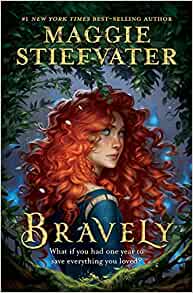
Maggie Stiefvater Creates a Brave(ly) New World: BRAVELY Review

Why, hello there. It’s been a hot minute, hasn’t it? Been relying on Bookstagram as my venue of choice for the past few months, but a new Maggie Stiefvater ARC will always inspire an un-social media amount of words and thoughts and feelings so LET’S. GO.

I should start with the disclaimer that I’ve avoided all of the Disney Press and Disney-Hyperion remix books for middle grade and YA readers so far, which makes me rather a snob. Why mess with a good thing? Isn’t that a cynical cash grab? Just leave your movies alone, Disney. To be honest, if Bravely weren’t written by my beloved Maggie, master craftsperson that she is, I most likely wouldn’t have picked it up.

Holy shit, am I glad I did.

Is this a sequel to the first Pixar movie to feature female leads, taking place a few years after the events of Brave? Yes, in the sense that all of the characters and places have the same names and the movie’s events are alluded two once or twice. But this story about ancient Scottish mythological beings and the balance between ruin and creation and the nature of true personal change is 100% pure heroin Stiefvater. I am a diehard fan of The Raven Cycle, and revisiting the TRC world through The Dreamer Trilogy has been such a gift for the past few years, but watching Stiefvater sink her creative teeth into a completely new world and mythology is thrilling.

THE STORY

I want to keep this post more spoiler-free than usual, since I’m posting so far before publication (May 3, 2022). Which will be tricky, but here goes.

A few years after the events of Brave, all is well in the kingdom of DunBroch. Merida leads a cozy, if repetitive, life, and so does everyone else in her family. The king is still jolly, the queen is still proper, the triplets are still mischievous, Merida is still fiercely independent. But DunBroch has attracted the attention of outside forces: not only a warlord threatening the borders, but also the Callieach, the Scottish goddess of creation, and Feradach, the god of ruin and destruction. When Merida happens to catch Feradach about to begin his destructive work on DunBroch, she makes a bargain with the god and goddess: now she has one year to bring change to DunBroch and her family members and undo her home’s death sentence. Thus begins a series of journeys, quests, battles internal and external, and a deeper appreciation for the close association between destruction and growth.

THE BABBLE

A reader doesn’t need to have seen the film at all to enjoy this novel. Stiefvater takes this world and these characters and makes them her own, giving them her distinctive flavor of dialogue and wit. Is it nice to hold in your head the film’s stunning visuals of Merida’s wild red hair as she gallops on her horse through the Scottish countryside? (Still need to do that before I die, by the way.) Of course it’s nice. But Stiefvater proves more than up to the task of bringing the world to vivid life anew, and in some ways, I wish I’d been able to meet Merida for the first time through her eyes, rather than occasionally thinking of the cartoon character created mostly by men.

The triplets, in particular, are tweens/early teens now, and each gets his own personality and character arc. The world around DunBroch expands in a way that feels “historical-ish” but still holds an air of myth about it. Feradach and the Callieach will steal your heart.

My only slight stumble is the epilogue: I’ve read it two or three times now and…I’m still not entirely sure what it’s saying. I think it’s meant to give me hope about certain plot developments? But maybe not. Normally I would give a book ***1/2 stars for a quibble like that but, just like the Callieach, when I am partial to someone, I cheat.

RATING

****

RANDOM BABBLE

  • I love how Stiefvater sprinkles two or three occurrences of “change DunBroch’s fate” throughout the novel. Clever callback to the movie, and it reclaims the phrase, raising the stakes from a petulant teenager’s catchphrase to the quest to save an entire kingdom from a destructive god.
  • There’s a new character named Leezie and she’s great. Trust me on that.
  • The novel gives wonderful nuance to the concept of whether or not you can change another person (or manipulate them into situations where they might change themselves).
  • I’m fascinated to learn more about how this book came into being. It seems different than the other Disney titles – not part of the Twisted Tales series, for example. Did Disney approach Stiefvater based on her previous work and her unique background? Or did Stiefvater’s agent pitch Disney the story idea (I think Maggie said at one point that she’s been playing with some of these ideas for ages)? It doesn’t really matter, but it would explain why the book feels like it could easily have been a novel about a different fantasy royal family, that just happens to be about the family from Brave.

What’s your favorite Stiefvater read? Are you excited to dive into Bravely?

I’ll Never Let Go, Luck: LUCK OF THE TITANIC Review

Grad school semester finished and family emergency [mostly] addressed, I have time to write blog posts again!

And apologies for the terrible post title, but I just couldn’t help myself. Hopefully it conveys how much I really really really loved this new look at the Titanic voyage. It is in turns enlightening, hilarious, enraging, inspiring, heartbreaking, and hopeful. Stacey Lee has created a wonderful new heroine in Valora Luck and given us a brand new perspective on a story that most of us thought we didn’t need to hear told again.

I’m not a high school teacher, but if I were, I would try to find a way to work Luck of the Titanic into my curriculum somehow.

THE STORY

Valora and Jamie Luck are twins, children of a Chinese man and a British woman, who grew up holding poverty at bay with their parents. With both their parents dead now, the siblings are one another’s only family, but Valora hasn’t seen Jamie in years since he left London to find work elsewhere. Now she’s finally tracked him down: as part of a Chinese-British engine room team that’s supposed to be working the maiden voyage for the largest, most luxurious ocean liner in history. As it turns out, the wealthy woman that Val serves as a housemaid has also bought tickets for both herself and Val on that same ocean liner — and Val sees no reason why her mistress’ last-minute death should prevent her reunion with her brother. Instead, she sneaks on board and, once there, blusters her way into posing as her former employer. She must keep her face hidden, however, to evade the Chinese Exclusion Act, which will prevent any person of Chinese descent from entering the United States without special permission.

Val has a plan to get that permission: when they were children she and Jamie trained themselves to be incredible acrobatic street performers, hustling on London street corners to help their family eat. Val knows that a talent recruiter for Ringling Bros. Circus is on board, and she intends to convince him to hire both of them as legitimate American immigrants. Jamie, however, has found a new home with his engine room crew (the “Johnnies”), and doesn’t seem too keen on going to America to join the circus. Thus begins a story of push and pull, with Jamie regaining his hope and Val gradually joining his new family on the lower decks. All the while, Val must keep her secret identity from being discovered. And of course the Titanic and a certain iceberg have irreversible plans of their own.

THE BABBLE

[From here there be spoilers. But not too many because I don’t want to spoil it for you.]

So let’s just get the most important question out of the way first: is this book an adaptation of the movie Titanic? No. And…also kinda yes? I haven’t had a chance to ask Stacey Lee (not yet, though we live in the same area so maybe I’ll get the chance one day) but I have to believe that some of the parallels between Val’s story and the movie plot are intentional. There are similarities in the first class/lower class deck contrasts, a main character getting imprisoned right when the ship starts going down, parts of the final sequence, the cruelty toward the lower class passengers, even hints of a cross-class romance…and so on. But the beauty of those parallels is the way that Lee either subverts the movie’s most famous moments or shines a new light on them through the lens of racial prejudice.

Look, I’m a child of the 90s, so that movie is branded into my psyche. I’ve always thought that one of the more haunting images in the film is the moment when the ship’s crew members, a dozen decks above, lock the doors to the flooding engine rooms and effectively sacrifice the lives of any workers still left in those engine rooms. That’s a haunting image, but Stacey Lee has written an entire novel about the people staffing those engine rooms. Their hopes, their fears, the racism they faced even among other workers in their same class and line of work. She does such a great job of establishing those characters that I actually forgot, for about two-thirds of the book, that OOPS none of the stuff the characters were working toward was ever going to happen because the boat still had to sink.

And the final boat sinking sequence is devastatingly described. Lee tells it in such brilliant detail, you’ll feel as though you’re right there with the characters. That’s all I’m going to say because spoilers.

To be honest, this lands just under 4 stars for me because of the final two pages, which drop some serious plot reveals for which I wanted a little more explanation. I 100% understand why Lee made that stylistic choice, and it’s effective, but still…I wanted the story behind a few of those outcomes.

Seriously though, who cares? This novel is wonderful and so unique. Go forth and read!

RATING

****

RANDOM BABBLE

  • I loved Val’s arc in this novel related to her parents, the way she slowly comes to grips with the fact that Jamie doesn’t share her affections or even her memories of her father.
  • I did some Googling and as far as I can tell, April Hart was not a real person. Which makes me so, so sad.
  • I was grateful that the quietly building romance between Val and Bo didn’t overwhelm the story at all.
  • Excuse me while I go read everything else Stacey Lee has ever written, including and especially The Downstairs Girl, which I already knew I should have read by now…

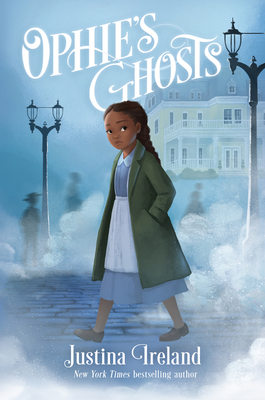
Racism History with Ghosts and Mystery: OPHIE’S GHOSTS is a Must-Read Spring Release

“It filled her with a sense of ease, and as they approached, she spun around, taking in the small part of Pittsburgh where it seemed that being a Negro was no more unusual than wearing a hat.”

Justina Ireland, OPHIE’S GHOSTS

[Note: this review covers an advance reader’s copy provided by HarperCollins.]

I’m always on the lookout for middle grade titles that discuss America’s racist history and/or present in ways that 1) don’t talk down to their audience and 2) won’t make readers feel like they’re in school. Ophie’s Ghosts, Justina Ireland’s middle grade debut that’s scheduled to come out in May, just joined The Parker Inheritance at the top of my recommendation list.

This book pulls no punches when it comes to the way black people were treated by white people – and sometimes by fellow black people – during the 1920s. But it wraps those punches in an intriguing mystery full of haunted houses, ghosts, and complicated characters. Basically: go order this one right now!

THE STORY

Twelve-year-old Ophelia has an unusual talent: she can see and interact with ghosts. She learns about this talent one night when it saves her and her mother from death at the hands of the Ku Klux Klan. Fleeing Georgia with no money and little hope, they find refuge crashing with relatives in the rapidly growing industrial city of Pittsburgh. Soon Ophie’s mother, desperate to move out of their relatives’ house, pulls Ophie out of school to begin working with her as full time house staff for the white and wealthy Caruthers family.

Unfortunately for Ophie, her job at the Caruthers mansion turns out to be waiting on the elderly, bed-ridden, and abominably racist Caruthers matron. Also unfortunately for Ophie, the mansion turns out to be haunted by its past — literally haunted, as in haunted by ghosts. The other black staff members are terrified of Mrs. Caruthers, and everyone keeps making hushed references to the woman who used to have Ophie’s position. When Ophie befriends a young female ghost in the attic who can’t remember how she died, it’s up to Ophie to uncover the truth.

THE BABBLE

I love that Justina Ireland establishes a whole set of rules and mythology for the afterlife, while never becoming so busy focusing on the ghost story that she allows us to forget both the casual and aggressive racism that Ophie and her mother face every day.

The mystery is a slow burn–one that younger children in the middle grade range might find a little too slow, honestly, but for more patient readers it’s worth the wait. I found myself constantly amazed by the number of dimensions of white supremacy and racism that this middle grade ghost story winds up addressing: not just overt “bad guy” stuff from the KKK members and Mrs. Caruthers, but also colorism, microaggressions, passing, segregation in the south versus the north, and so on. The sequence when Ophie attends the movies with Clara, and she finds herself gaping at an entire functioning mini-society filled with people who look just like her, was heartwarming and devastating at the same time.

That sequence soon also became incredibly creepy, as do most of the ghostly moments in this novel. The ghosts in this world are genuinely spooky.

One last observation: it might just be an accident of timing, but this is the second occasion in the past year when I’ve read an #ownvoices novel starring a BIPOC character, shortly after reading a novel with a similar theme/plot written by a white author. The first time this happened, I read Tracy Deonn’s Legendborn shortly after reading Leigh Bardugo’s Ninth House, both of which follow a female black student on scholarship to an elite college, where she joins an ancient secret society of wealthy students that abuse magic in order to reinforce their privilege. This time, I read Ophie’s Ghosts after reading Cat Winters’ The Steep and Thorny Way, a loose YA adaptation of Hamlet in which a black teenager – also named Ophelia, interestingly enough – tries to avoid the rise of the KKK in 1920s Oregon after seeing the ghost of her dead father. Both cases serve as excellent examples for why #ownvoices publishing is so important, because in both cases, the BIPOC authors brought different levels of nuance and different areas of focus to similar stories, themes, and explorations. I enjoyed both Ninth House and The Steep and Thorny Way, and I’m not ready to say that only members of marginalized populations should be “allowed” to tell stories about those populations (Winters in particular did a ton of research and involved sensitivity readers in her writing process). HOWEVER. These two recent cases perfectly illustrate why from now on, for every Ninth House that’s published, there’d better a Legendborn published (preferably two Legendborns). For every The Steep and Thorny Way, there needs to be an Ophie’s Ghosts. It’s up to publishers to make that happen, but it’s also up to us as readers — and, more importantly, as buyers — to hold publishers to the fire to make sure it happens.

Anyway, soapbox aside, Ophie’s Ghosts is fantastic. I hope teachers read it and incorporate it into their lesson plans – I think it’s a worthy successor to Roll of Thunder, Hear My Cry. Ophie makes an engaging, opinionated, sympathetic heroine from the first page, and the characters around her are just as detailed. It’s a unique approach to this important and all-too-relevant subject, written in a modern style.

RATING

* * * *

RANDOM BABBLE

[From here there be mild spoilers. Ye have been warned.]

  • I know I said it above, but some of the ghost encounters are friggin’ creepy. Dining room lady? Creepy. That rose garden scene? SUPER creepy. Honestly, they might be a little scary for younger readers, but it will depend on the reader.
  • A testament to how well Ireland immediately establishes this world, and these characters, and the stakes that impact them: I had tears in my eyes by the end of the prologue.
  • The mystery about Clara is such a slow burn, yet I still didn’t see part of that final reveal coming. Props to Ireland for that.
  • Ophie’s dream to be back in school is gutting, and I appreciate that Ireland incorporates child labor into this story. A great way to discuss how school wasn’t mandatory for all children in the U.S. until 1930, and wasn’t strictly enforced for many years.
  • I thought Ireland did a skillful job of weaving the different ways that Ophie and her mother are processing, or failing to process, their grief about Ophie’s father throughout the story, without allowing that to overwhelm the story or their relationship.
  • Oh yeah, in case I haven’t made this abundantly clear elsewhere: