THE WATER BEARS Review: Whimsy with a Dollop of Trauma

“People always ask if I’m okay,” I said. “But I don’t think I have the same kind of okay as them anymore. They just want me to say I’m good so they feel better.”

THE WATER BEARS, Kim Baker, 2020

The newer middle grade novels I read often fall into two broad categories: whimsical books about fantasy and magic and maybe a dash of sci fi, and realistic novels about the trials of middle/elementary school or processing family issues/racial issues/sexual issues/other trauma issues and so on. I love both categories, of course, but I’ve rarely seen them overlap as charmingly or uniquely as they do in The Water Bears.

Folks, is it just me, or are we living in a new golden age of middle grade fiction? I can’t believe how many newer novels I’ve picked up in recent months that manage to both honor the feel of the “classics” and also address relevant social questions in a fun, engaging, literary way. There’s just so much good writing out there. It almost makes me wish I were still a kid…but I’m glad my job gives me an excuse to read lots of children’s literature, which is the next best thing.

the story

Newt lives with his family on [sadly fictional] Murphy Island, a quirky artist colony that feels like an Island of Misfit Toys for families. Newt hates standing out, and unfortunately he stands out for two reasons: one, he belongs to the only Latinx family on the island, and two, last summer he survived a bear attack and still struggles with a leg injury and mobility issues. He would love nothing more than to escape the island altogether to live with the rest of his extended Latinx family on the mainland, where he thinks he can start fresh and won’t always be known as That Poor Kid Who Got Attacked by a Bear. Plus, he’s still dealing with nightmares and other PTSD symptoms from the attack.

Sounds like a good Realism Novel for this age group, yeah? Only that doesn’t factor in a mythical lake beast, a bear statue carved from driftwood that may or may not grant wishes, a thirteen-year-old allowed to drive a retired food truck while all the adults look the other way, an annual circus talent show that provides catharsis for Newt and his guilt-stricken mother, a mysterious truck-napping stranger, goats in the house, an island full of wild parrots and monkeys and abandoned resort trappings, and much more. Throughout the novel Newt navigates his friendship with Ethan, a fellow island resident who adores living on the island in all its whimsical glory, and a new island arrival named Izzy.

THE BABBLE

[From here there be spoilers. Ye have been warned.]

It used to be said that children had no sense of irony, that what distinguished children from adults was their sincerity, their acceptance, their openness. Not for the child was the jaded weariness of grown-up life, the disappointments in friends, family, and leadership. But children have been coming into their ironic own for decades…They learn that people lie. They learn, too, that their own beliefs may not be shared by others.

CHILDREN’S LITERATURE: A READER’S HISTORY FROM AESOP TO HARRY POTTER, Seth Lerer, 2008

The Water Bears is so full of whimsy it should have no room to sensitively explore residual trauma, yet it does so. It shouldn’t work. It does work, beautifully, and I loved it.

The island setting is richly painted through imaginative details based on an abandoned resort that once provided a long-ago tourist attraction and now provides crumbling infrastructure: for instance, the parrots once used in an entertainment show that have now formed the island’s own native wild flock; the small alternate school for island families where kids eat their lunch in the resort’s drained swimming pool; the bell that can be heard throughout the island to signal for tourists when whales have been sighted–or when a terrible storm is coming.

I also loved the way that the book handles trauma processing, not only in how Newt gradually processes his attack but in the way his whole family deals with it. His mother clearly still struggles with the incident and her (largely blameless) role in it — the guilt has cost her a friendship, and one of her primary sources of joy. Newt’s veteran brother connects to him by recommending a PTSD therapist. I love that his little sister even gets a chance to talk about how his injury and recovery has impacted her life. And Newt? The novel paints a beautiful portrait of an adolescent boy who suffered a highly unusual attack, and has allowed injury and self-consciousness to define who he is. Something undeniably weird has happened to him, at precisely the time in life when no one wants to be associated with anything weird.

Newt’s weariness at playacting “okay,” his desire to just escape the claustrophobic island community and start over, his illogical fear of places and people associated with the time of the attack…it’s all so relatable and so genuine. As a former survivor of a traumatic accident (that had everyone asking how I’m doing for years and, honestly, 16 years later people in my hometown are still asking me that question when they see me), I related to Newt’s struggle. As an actress, I love that an anonymous reconnection with the joy of live performance helped him down the road to recovery.

My only small question relates to the eponymous water bears themselves, microscopic organisms that Newt discovers and researches for a school report. I get that the little creatures’ name keeps in line with the whimsical recurrence of bears in Newt’s life, and that their ability to survive in even the most difficult environments is symbolic of Newt’s resilience. But still, something about their repeated appearance felt a little shoehorned in to me — almost as if Baker initially featured them in one chapter, and the publisher/editor made her come back to them multiple times because of the manuscript title? But it’s not a major issue or anything.

Another observation – and this isn’t a complaint, just something that caught my eye – deals with Izzy. She reminded me very much of Jolene in Here in the Real World by Sara Pennypacker (also an amazing 2020 novel), which makes Izzy the second iteration I’ve encountered this year of an emerging female character type in middle grade novels featuring boy lead characters: the fascinating girl with a tragic home life who becomes a new friend to the shy protagonist. She coaxes him out of his awkward preteen turtle shell by broadening his worldview and awakening both his compassion and his protective instincts. What should we call this type? Not the Manic Pixie Dream Girl, since it’s middle grade so these are (largely) friendly relationships rather than romantic ones. Maybe the MPDG’s spunky little sister, the Tragic Pixie Friend Girl? Anyway, it’s an interesting trend. I don’t necessarily feel one way or the other about it yet, just wanted to note it here.

Also, I’ve included the Seth Lerer quote above from another book I recently finished (I don’t 100% agree with all of Lerer’s frameworks, but it’s still a great read if you love children’s literature) because I think it pairs well with the quote from Water Bears at the top. Sometimes a child narrator’s disillusionment comes across as smartass. Other times it breaks your heart. The Water Bears will break your heart and make you smile…and make you extremely sad that Murphy Island isn’t a real place open to visitors. I hope it gets serious consideration for this year’s Newberry Medal.

RATING

*** 1/2 out of 4

RANDOM BABBLE

  • I’m generally not a fan of goats in real life (one tried to eat my hair when I was little and I’ve been in a fight with goats ever since), but I’m a fan of the goats in this book, which just shows how delightfully Baker portrays the goat members of the Gomez family.
  • I appreciate that Baker resisted the urge to have Newt see Marvelo at the end of the book. A more cliched book would have done that, but it feels more appropriate for Ethan to see the mythical beast.
  • I died laughing during every sequence that involved driving The Rooster. Whimsical comedy to the max.
  • Sweet Ethan. What a good kid. It’s so friggin’ hard to be abandoned by a best friend, and my heart broke for him when Newt told him he was moving to the mainland.
  • I also love that the very scenario of Newt’s trauma – a bear attack while berry picking in the brambles – sounds like something whimsical out of a children’s book. But for Newt, it’s anything but.

A COURT OF THORNS AND ROSES Review: Beauty and the SortaBeast

Against slavery, against tyranny, I would gladly go to my death, no matter whose freedom I was defending.

A Court of Thorns and Roses, Sarah J. Maas, 2015

After my last post about A Midsummer Night’s Dream, I feel like I’m on a roll with this whole Faerie lore and questionable sex-with-beasts thing, so let’s turn to a story that at least involves fewer issues around consent, shall we?

Sarah J. Maas titles sell like crazy at the bookstore where I work, so I’ve been curious to see what all the fuss is about. This is my first Sarah J. Maas novel and I enjoyed it. I love me some dark fairy tales, and I’m loving the dark faerie revival in YA fantasy. Faeries are clearly the new vampires in YA and I’m here for it — faerie lore feels much more varied and interesting than vampire lore, honestly. (How much can there be to vampire lore? They bite. They fight. They brood. Sometimes they sparkle.) Holly Black is one of my absolute favorite fantasy authors, Melissa Albert is another, and while the Gathering of Faerie books aren’t my favorite of Maggie Stiefvater’s novels (I’m ride or die for Scorpio Races and everything that’s come since, especially The Raven Cycle), they certainly stand head and shoulders above most fantasy books out there. A Court of Thorns and Roses is another fine entry in this genre, as well as a fresh new take on Beauty and the Beast.

And lordy lordy, So. Much. Happens. In this book.

the story

Folks, I just…there is an impressive amount of plot in this novel. So much that by the time I got to the part where most novels would be gearing up for the climactic finale, I was stunned to realize I still had quite a bit of book left to go. (Cue obligatory comparison to Return of the King‘s multiple endings, except that I’m a giant LOTR fan who will argue that each of those endings was dramatically necessary and that, furthermore, the book has even more endings, so really Peter Jackson cut us a break.)

Anyhoo. So. Our heroine is Belle Feyre, and she is a total badass huntress who lives on the edge of town, which lies on the border of Prythian, better known for all intents and purposes as the land of Faerie. In this universe, Faeries once ruled over humans and worked them as laborers before the humans revolted and formed an uneasy treaty many years ago. Feyre spends her days hunting, Katniss-style, to feed and take care of her ungrateful sisters and father. Her family used to be wealthy but times have changed – though she seems to be the only member of the family to have changed with the times.

One day she slays the wrong wolf on a hunt: it’s actually a Faerie warrior in wolf form. Soon that Faerie’s friend, in even bigger Beast form, breaks down her family’s door and steals her away with him to Prythian in retribution. Once in Prythian, she discovers that the Beast is one of the seven High Lords of Faerie, and also Lord of the Spring Court, which is to be her new home. Because this is a Beauty and the Beast adaptation, you know this story. Turns out the Beast/High Lord, name of Tamlin, isn’t all that beastly after all once you get to know him, they fall in love, etc.

[FROM HERE THERE BE SPOILERS. YE HAVE BEEN WARNED.]

But not too many spoilers, because seriously, trying to sum up this whole story would take me all day. Suffice it to say that Tamlin and his court are cursed, including Feyre’s attendant/ally/friend Mrs. Potts Alis; Tamlin needs the love of a human who hates faeries to break the curse; also there’s an evil High Queen of Prythian who loves Tamlin (?!) and that’s why she cursed him, which seems a bit much but whatever; and Feyre has to go through a lot of torture and trials before love can prevail. Oh, and also Feyre meets another hot High Lord who seems obsessed with her, and this one has dark hair instead of blonde hair, so you know there must be a love triangle on the way.

the babble

I love Maas’ lush writing style, her vivid descriptions, and the detailed world she’s created here. And damned if she doesn’t know how to write an action sequence. The lore of her particular brand of Faerie culture sounds fascinating, and I look forward to learning more about it in the rest of the books, which I plan to read at some point.

I also appreciated her twists on traditional fairy tale tropes. The strained family dynamics between Feyre and her sisters and her father were so compelling, like something straight out of the Brothers Grimm. And the “impossible tasks” she must complete once she’s imprisoned Under the Mountain — especially the moment when Lucien’s mother helps her with cleaning the floor — come straight from Rumplestiltskin or an old Baba Yaga tale. It’s delicious storytelling.

Here’s the slight problem: I cared way more about those things than I did about Feyre’s love story with Tamlin — or her budding connection with Rhysand, for that matter. (I’ve had multiple friends look like they’re about to explode from holding in spoilers when I talk about how unconvincing I found Feyre’s soulmate connection to Tamlin and YES I GET IT, GUYS, MAAS IS SETTING UP RHYSAND AS A SECOND LOVE INTEREST.) I would much rather have read more scenes between Feyre and her complicated sister Nesta, or Feyre and Lucien, or Feyre and Alis. Those relationships felt far more compelling to me than her conversations (verbal or physical, *ahem*) with either High Lord. Maybe I’m just getting old and jaded, or maybe it’s that the physical descriptions of Tamlin and Rhysand make them sound like a direct retread of the Rob/Gabriel love triangle from L.J. Smith’s Dark Visions trilogy, which I already read and adored back when I was the right age to believe that true love can bloom just because two people are pretty and because the author tells you it’s blooming. Regardless, while I care about both Feyre and Tamlin in their own right and I’m glad they’re happy (for now?), I don’t feel Maas gave them enough scenes to let their relationship grow naturally.

Also, could it be? Yes it could! A Court of Thorns and Roses brings us to this blog’s first encounter with the YA Green Eyed Love Interest phenomenon, in which YA love interests (usually male, sometimes female) disproportionately have green eyes. Which means this novel receives Bookshelves and Babble’s inaugural Green Eye Eye Roll:

rating

***ish out of 4, but mostly because this blog is public and I don’t want hordes of Maas fans to descend upon me

random babble

  • The scene where Feyre kills that giant worm monster is harrowing and excellently plotted. Feyre is such a badass.
  • I love that Feyre’s name plays on both “faerie” and “fair,” as in beautiful. Well done, Maas.
  • Anyone else out there a Feyre/Lucien shipper, or is it just me? Lucien is the best. More Lucien, please.
  • The structure of this story felt a little…lopsided. The first half or so took its time and was so rich in character development and detail, while the second half felt like a great rush of plot reveals and explanations. And not to be a grouch, but Amarantha’s curse on the Spring Court is oddly and conveniently specific…almost as if it was custom-tailored to suit Feyre and get us to exactly this point in the book! What are the chances.
  • I enjoyed Feyre’s artistic passions and her love of painting. Art provided a great way for Maas to show us the ways in which Prythian has been good for Feyre: after witnessing how she strangled her talent to take care of her family back home, she can finally allow her art to grow and blossom in the Spring Court.
  • Two facts about Teenage Kristin that might help put my reaction to this novel in perspective: (1) While I still enjoy these stories, I especially loved romantic fanstasy/sci fi when I was in middle school and high school. L.J. Smith was my favorite author at the time. I was all about cross-magical species soulmate stories, so if I were still a teen I would probably think this was the most brilliant book I’d ever read and give it 4 out of 4 stars. Except that (2) Teenage Kristin was also an insufferable, prudish Goody Two-Shoes, so those Feyre/Tamlin sex scenes would have made my skin crawl as a teen, just like similar scenes did when I read Stephen King and such. I’m not about to yuck anyone’s yum and I’m definitely about to date myself here, but I can’t help but remember people in my hometown raising eyebrows because a Christopher Pike YA novel described sex in a single sentence. Feyre and Tamlin get whole paragraphs that tell you exactly where he puts his hands and his mouth and his tongue and the like. It’s steamy AF (literally AF). I think he actually rips her literal bodice in beast form at some point. Damn, y’all. BUT. All that being said, I’m here for this new trend of YA sex scenes modeling very clear consent between both partners. (Though I would argue that their first encounter, after the Fire Night celebration, very much does not model consent and instead perpetuates the harmful stereotype of a woman being turned on after the man doesn’t listen to her saying “no” and continues his advances. The fact that he’s magically transformed by a ritual into beast form doesn’t entirely excuse that. So…a draw, then, on the consent issue?)
  • Along the same lines, dear reader, what are your thoughts on this whole “new adult” marketing label in fiction? Do you have the same mixed feelings about it that I do? I understand not wanting to potentially restrict access by placing more mature YA books in the adult section, but…I didn’t have any trouble walking over to the adult fantasy/science fiction section when I was a kid, did you? I took a class related to this subject last semester in my MLIS program and it’s such a thorny discussion topic. (Points if you got my pun there.)

A Midsummer Night’s Fluid Sexuality Party: Thoughts on the National Theatre’s A MIDSUMMER NIGHT’S DREAM

Taking a break from books for a second to talk about something equally nerdy, I just barely got in a watch of National Theatre at Home‘s A Midsummer Night’s Dream before Les Blancs replaces it today, and I have so many thoughts. Enough to fill a post, methinks.

I remember reading a few reviews about the production last year when it was up and running, and I remember it sounded interesting and explosive, and then I promptly forgot about it beyond some gorgeous photos of Gwendoline Christie beaming from an aerial silk hammock. And Christie is mostly great in this, but there’s so much more to talk about. So here’s a thought roundup from your resident Shakespeare geek.

But let’s answer your most burning question first: after watching A Midsummer Night’s Dream, does my crush on Oliver Chris remain intact? Yes, dear reader, it does. I loved him in One Man, Two Guvnors, I loved him in Twelfth Night, I loved him in the excellent new film version of Emma, and I really, really love him in this. The guy can make Shakespearean verse sing like nobody’s business. He has a talent for making me notice lines I’ve never focused on before, even in plays I’ve seen and read a gazillion times (like Midsummer and Twelfth Night). He also manages to make me genuinely care about characters whom I usually dislike: he’s still the only Orsino I’ve ever felt even remotely sorry for, and his Theseus is mesmerizing in the beginning and charming at the end. Who the hell is Theseus, many of you might be wondering right now? And well might you ask, because he’s one of Shakespeare’s classic Forgettable Plot Machine Authority Figures. But not when Oliver Chris plays him.

Which brings me to the first scene. I have never, nor probably ever will again, seen a production of Midsummer in which I thought the first fifteen minutes were the most powerful of the show. Usually, Act 1 Scene 1 of Midsummer is a fifteen-minute slog of exposition dump that must be dutifully borne until the Mechanicals come onstage and make us laugh with (hopefully) a lot of physical comedy and (hopefully) that stupid joke about beards cut from the script, and then we get to the woods where things really start cookin.’ Not this time. I loved the Handmaid’s Tale-Gilead-style setup, and while I initially rolled my eyes about Concept Shakespeare Nonsense when they carried out Gwendoline Christie in a glass box, it quickly became clear that the box held a place in this restrictive misogynistic society. From Christie’s expressions and reactions to Chris’ nuanced delivery, Theseus’ opening monologue established that this entire scene was going to have STAKES.

Which it should — Shakespeare’s comedies should always feel like they have life-or-death stakes, that’s what makes the endings land, at least in theory — but this production truly made the stakes punch you in the gut. Not just through Thesus’ and Egeus’ oppressive behavior toward the lovers and Hippolyta, but in Hermia’s fear, that gorgeous silent moment between Hermia and Hippolyta before the former bravely speaks up for herself, in the furtive way that she and Lysander plan their escape, and even in Helena’s fearful reaction to their plans and her flash of jealousy about escaping.

Which leads me, briefly, to Hermia, before I get on with the flashiest part of this production. I’ve seen two professional UK productions of Midsummer now, this one and the RSC’s 2008 production, and I loved both for giving Hermia’s heartbreak its proper weight. Especially once you get to the lovers’ quarrel later on, I feel like too many productions get focused on a slapstick pace and don’t slow down long enough to let her pain land, and that’s not fair to the character or her story. I thought Isis Hainsworth was heartbreaking and hilarious and I’m glad she got nominated for an award.

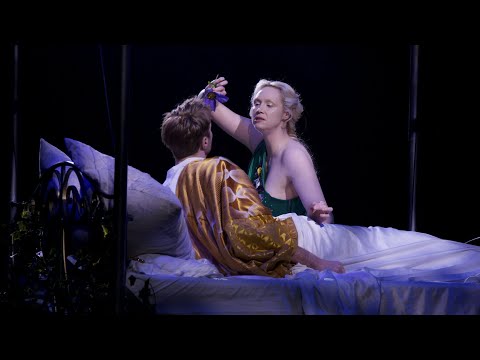
Okay, let’s talk about the production’s main gimmick, if you will, which is the role-flipping of Titania and Oberon in the potion plot. You know what? After a few initial moments where my brain had to adjust to hearing lines coming out of the “wrong” characters’ mouths, this worked for me! You wouldn’t think it would change that much about the play, or make you focus on how gendered that entire plot arc is, but holy shit does it ever. It had some immediate positives and negatives, though. Positives: hearing Oliver Chris deliver Titania’s gorgeous speeches about climate change, and some fascinating new motivations for Titania’s revenge plot. At least to my eyes, Oberon talking about his beloved dead votaress definitely made it sound as though he had an affair with said votaress–and Titania’s face in the background made it pretty clear that’s what she heard, too. From her perspective, he follows up an argument they’ve just had about adultery with…a story about another affair he had. From my way of thinking, this is the “injury” she wants Puck to help her revenge, as much as wanting the votaress’ son as a new henchman for herself. The fighting-over-a-new-henchman thing has always made Oberon seem like such a spoiled manbaby, and definitely NOT a good reason to roofie your wife into beastiality so you can shame her into giving you something you want (not that any legit reason for that behavior exists). So, points for a new motivation. Negative: since Chris gets to speak Titania’s most famous text here, it wound up feeling like Gwendoline Christie wasn’t left with much to do except be a powerful presence on stage — which, you know, Lady/Ser Brienne of Tarth can definitely pull that off. I went in to the show so excited to watch her perform, and so tuned in to her performance, that it ultimately highlighted for me how much the character of Oberon is really just an exposition machine masquerading as a diabolical genius.

Case in point. See? They’re so adorable and sweet and cuddly (truly, they are!) if not for those pesky power dynamics issues.

And okay, yes, now it’s time to talk about my biggest issue with this production. First, I want to preface this by saying that I really loved Hammed Animashaun’s performance as Bottom the Weaver (he also very much deserved his award nomination). His version of the role was fun and goofy and unusually sweet, and I found myself rooting for his Bottom during the play within a play, rather than my usual thoughts of “Stop stealing focus from your scene partners, you jerk.” That being said, regardless of whether Oberon’s playing the love potion prank on Titania or Titania’s playing the love potion prank on Oberon, the entire prank revolves around disgust. The victim is supposed to fall into a loving relationship they would normally find abhorrent. Retooling the show so that said relationship is a same-sex one on top of a beastial one is already tricky to navigate: I think this show just managed to dance around it by making it clear that there was genuine attraction and affection between Oberon and Bottom the Weaver (sorry, I’m immature so in this particular context calling him simply Bottom makes me gigglesnort). Just barely. But Animashaun is a BIPOC actor, or at least a black-presenting actor, and this is one of those productions where the costume designer has decided that his “transformation” will only be a pair of ears on a fancy headband, leaving his face fully visible. So what the audience sees is basically a black man in modern dress being called a monster, being called a fool, being called an animal, and being forced to stay in the woods by a white man who holds all the power and wants to have sex with him. I noted that they removed Titania’s (here Oberon’s) line “My eyes do loathe his visage now” once the enchantment wears off, but still. Even before the recent BLM context of 2020 came to the forefront of our conversations, that was…yikes. Not okay. Did that come up in the rehearsal room at all? I’m so curious. Again, the actors sell it, because in Animashaun’s portrayal there is true consent happening in response to Oberon’s proposition, and their scenes together are so damn charming, heaven bless both of these men. But at least in the U.S., there’s an undeniable power dynamic at play between white faces and black faces that you can’t just ignore in a storyline that’s already fucked up when it comes to consent issues, whimsical fairyland rules or no. (I love A Midsummer Night’s Dream, you guys, it’s one of my favorites, but it’s got some issues.) I’m not trying to say that a talented BIPOC actor should never play Bottom the Weaver opposite a white Titania (or Titania/Oberon hybrid) ever again or anything, but…casting directors really, really need to think that particular pairing through for a while.

OTHER RANDOM STUFF I LOVED:

  • Aerial work. I’m a sucker for it.
  • Along those lines, Puck’s physicality was incredible. Not entirely sure what was up with his vaguely tweaking-drug-addict vocal tic though – maybe it was supposed to match the punk costume he was wearing? It was clearly a deliberate choice, because he delivered his final speech without any of the vocal tics and it was so lovely and I screamed “Where has this been?!” at the TV.
  • Gwendoline Christie in THAT DRESS. YOU KNOW THE ONE I MEAN. Of COURSE that woman is the Fairy Queen. Duh.
THIS DRESS. THIS ONE RIGHT HERE.
  • Gwendoline Christie’s face acting. She speaks volumes in that first scene while barely speaking a word. When she finally gets to be witty during the play within a play scene, it’s such a rush.
  • Another thing both British Midsummers I’ve seen have done: they really go for that dirty “kissed thy stones” joke during the play within a play and I am here for it.
  • Another thing I’m here for: Hermia dropping an F-bomb in ad-lib. Normally I find modern speech ad-libs in Shakespeare productions annoying, but this time I enjoyed them. Puck had some great ones, and Theseus’ “Oh, it’s a hat” about the Lion costume broke me (and Gwendoline Christie, too, from the looks of things).
  • The “Give me your fist” joke with Mustardseed. I died. Normally that scene is so boring — and I say that as a Shakespeare fanatic — but they made it work.
  • Puck’s response to having to fetch Helena for Titania. And his gag about losing the flower. If I ever play Puck again, I’m so stealing that flower gag.
  • All of the lovers were strong. It’s nice when that happens.
  • I loved Starveling. She was so over it. Or maybe just pissed that she wasn’t playing Thisbe? It does make the cross-dressing joke more difficult if you have a mixed-gender group of Mechanicals and still insist on having Flute be male-presenting.
  • Just when you think the play within a play can never show you something new, Thisbe summons Hermia, Helena, and Hippolyta onto the stage within a stage for “O, sisters three,” and it’s a gorgeous moment.

other random stuff I didn’t love

  • I thought most of the costume design was…just, why? Except for the Gilead stuff at the beginning. And that dress. You know what, who are we kidding, all anyone is going to remember about costumes in this show is THAT DRESS, and possibly Oberon’s matching overcoat in the final scene.
  • I love the whole “the play was Theseus’ vision quest to learn about the importance of love and renounce hetero misogyny” thing, but the moment where he remembers his own dream was waaaaaaaaay oversold. As soon as the sound system started playing flashbacks of his own voice speaking words of love to Bottom the Weaver, I cringed and put my hands over my ears. Just fly the bed across the stage with a magical sound effect and let Oliver Chris and Gwendoline Christie do their brilliant acting. The audience is not stupid. Stop treating us like we’re stupid.
  • About Christie: I loved her as Hippolyta and she was an imposing presence as Titania, but did anyone else get the feeling she’d been directed to deliver her Oberon-reassigned-to-Titania lines, like, REALLY BIG AND LOUD WITH BIG, GRACEFUL ARM GESTURES? She obviously knows her way around Shakespearean text because there were plenty of lines she delivered with beautiful nuance. But there were also parts of her lines that she played as overexcited (“there the snake throws her enamell’d skin” was one, I remember) for seemingly no reason. It felt like a director’s choice made for pacing purposes. It was weird, and I don’t like directors who make my beloved Gwendoline look like anything other than the absolute goddess of everything that she is.
  • The same-sex kisses during the lover’s quarrel were, I’m guessing, meant to soften some of my objections above, by not making Oberon/Bottom the Weaver the only same-sex instance in the play, and painting the woods as a place where sexuality is a fluid thing to be joyfully explored? Which is a great idea, and would have worked much better for me if the staging of those moments hadn’t been so rushed.
  • Similarly, maybe it was impossible to shoot properly and you just had to be there, but the “up and down” chase sequence staging was…awkward and confusing? Having all four lovers end up tangled on a tiny bed might work for your visual metaphor but it doesn’t work for the scene. And the scene should always win.

There’s more, believe it or not, I’m sure there’s more, but I’ve already written more than I wrote for some of my college papers so I’ll stop there. If you made it this far, congratulations. In summary, watch National Theatre at Home every week and donate money! They produce beautiful, thought-provoking stuff and while it’s not the same as being there in person, the recordings are fantastic and give you a better seat for free than you could get for under the equivalent of $200.

Back to youth literature next time, promise!