

“Had I known you were my brother,” he says, his voice rough and trembling, “I would have forced you to leave on the very first day of her curse.”
I shake my head. “Had I known you were my brother, I would have stayed by your side just the same.”
Brigid Kemmerer, A VOW SO BOLD AND DEADLY
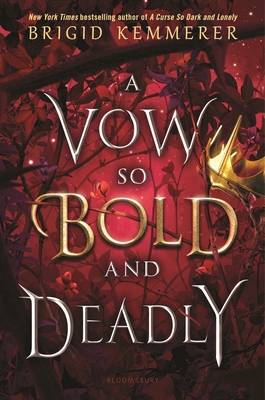
Is there any feeling so simultaneously filled with excitement and despair as beginning the final book in a series that you really love? Finally, you get to learn how the story ends! But that means the story is ending. After you finish, that’s it. No more new adventures with these characters. (At least in theory. In these days of blockbuster publishing, who knows.)
I love the Cursebreaker series. I flew through A Curse so Dark and Lonely in a single sitting. For a story whose basic bones have been told a gazillion times, I thought it was fresh and intricate and convincing and just fun. (Apparently YA Beauty and the Beast retellings are thing that I gravitate toward? Didn’t plan it that way, but what can you do.) I loved these characters and I wanted them to succeed. ALL of them. Which Kemmerer deliberately sets up as a problem.
The world of Emberfall and Syl Shallow is a world in which four potential rulers wish for peace, but the world itself might not be set up for peace. Kinda like our world. How can they navigate political rifts and potentially permanent rifts with one another? Can Kemmerer stick the landing after spending her entire second novel complicating the heroes from her first?
THE STORY SO FAR
[FROM HERE THERE BE SPOILERS FOR THE WHOLE SERIES. OBVIOUSLY.]
A Curse so Dark and Lonely sets out a particularly bleak Beauty and the Beast remix premise: the enchantress whom spoiled Prince Rhen refused was straight-up deranged and evil, and cursed him to become a deadly monster every few months that would wage terror upon his family and his people. In the interim months, or “season,” his one Royal guard left alive after the first few monster attacks will travel through a portal to a parallel realm to fetch a girl for the prince to woo. If the girl can fall in love with Rhen even after finding out that he’s the monster, then the curse is broken. If not, then monster Rhen probably kills some more people before the curse resets, at which point Rhen and his guard, Grey, return to exactly how they were at the beginning yet the dead remain dead (including Rhen’s entire family). For some reason, the magic portal opens into Washington, D.C. At the start of the novel, Grey accidentally brings back Harper, one of my favorite YA fantasy heroines in quite some time. Harper doesn’t take kindly to learning that she’s trapped in a fantasy kingdom called Emberfall, where the populace is struggling under threat of invasion from a neighboring kingdom called Syl Shallow. From here, it’s Beauty and the Beast, so you can guess how the story goes. But just take my word for it that it goes there very enjoyably, alternating POV between Harper and Rhen — except for a crucial final chapter from the POV of Grey.
A Heart so Fierce and Broken seems to spend most of its time undercutting Harper and Rhen, whom we grew to love in the first novel. We don’t get to spend much time with them, instead alternating POV between Grey and Lia Mara, elder daughter of the vicious queen of Syl Shallow. (While Lia Mara turns out to be an excellent heroine on her own and a worthwhile Harper stand-in, I found Grey a little wooden in this novel. He had more life in the first novel as a foil for Harper or Rhen. But perhaps that was the point–he’s still figuring out who he is away from them.) Turns out Grey is the real heir to the throne of Emberfall, the dead King’s first son with a different enchantress. That means Grey can also wield magic. Both of these facts combined absolutely terrify Rhen, who received the worst of the torture from the enchantress Lillith during Emberfall’s curse. Rhen’s PTSD inspires him to act violently toward his former guard and companion, and Grey becomes a fugitive and ally for Lia Mara, seeking asylum in Syl Shallow. Lia Mara, who wishes for her country to seek peace with Emberfall rather than invading, becomes queen of Syl Shallow by the novel’s end. In a final chapter from Rhen’s POV, we learn that Lillith survived Grey’s supposed death blow at the end of the first novel, and Rhen makes another deal with her: he will fight against Grey to keep his throne, if she will promise not to harm Harper.
THE STORY OF A VOW SO BOLD AND DEADLY
After two novels focusing on our two separate pairs of lovers, it’s time to mix them all together! Vow alternates between Team Emberfall and Team Syl Shallow, focusing on Harper and Rhen POV chapters for a little while before switching over to Grey and Lia Mara, and back again and back again. Neither kingdom is inclined to trust its current ruler: Lia Mara’s subjects don’t believe she’s bloodthirsty enough to rule effectively, and they fear Grey’s magic, while Rhen’s people protest that he isn’t the rightful heir. Moreover, while Grey and Lia Mara seem to have a functioning partnership, Harper’s partnership with Rhen is crumbling. She’s having trouble forgiving him for the way that he tortured Grey in the last novel, and he’s having trouble forgiving himself. Also, Lillith is back to emotionally, mentally, and physically abuse Rhen when no one’s watching. Harper and Rhen finally mend their relationship when Rhen confides in her about his new deal with Lillith, and Rhen agrees to seek peace. Only by then it’s too late: an enraged Lillith brutalizes Rhen and all in the castle, and Harper barely escapes with her life to Syl Shallow, where she begs for Grey’s help. Grey, Lia Mara, and their team do ultimately join in the fight to destroy Lillith…and because I don’t want to spoil everything for you, I’m not going to detail how, but let’s just say I cried. In the end, Rhen agrees to yield the throne to Grey and acts as his advisor.
THE BABBLE
Okie dokie. So. I love these characters, and with the exception of one quibble* (see below) I feel as though this final volume does right by them. Grey comes into his own not only as a leader but as a fleshed-out character in this book. I loved seeing the payoff of the hints that Kemmerer has laid for us all along that while we thought this was a fantasy-romance series about princes and plucky YA heroines–and it was that, sometimes–it was really a story about bromance through shared trauma, and how everyone processes trauma differently, and how blood family and found family can sometimes feel the same because they are literally the same. My gods, gentle reader, when I got to the end and Rhen was a monster again and Kemmerer gave us such a delicious twist on the now-tired Frozen trope and Grey went all “Come back to yourself, brother” I was SCREAMING and WEEPING…ahem. I loved that these two young men spend two whole novels claiming that they aren’t friends when they clearly are, and they clearly care for each other very much. Because of course they do. The glimpses Kemmerer gives us of what they suffered together are horrific. They are Samwise and Frodo and I love them.
In some ways, I found that connection a slight weakness as well as a strength, because so much of the characterization for both Rhen and Grey revolves around each character’s relation to the other. What does one think about the other at any given time, and vice versa? How is he reacting to the other’s actions? Harper and Lia Mara, by contrast, feel like much more fully-rounded characters on their own, Harper in particular. And that’s fine with me! If we’re talking about literature geared toward young people and we have to choose, then by all means, let’s please make sure the female characters are more developed than the male ones after many centuries of, you know, that not happening.
Here’s where we get to my small quibble, though: I thought the PTSD focus and narrative structure wound up being a little unfair to Rhen. I like Rhen and I think he’s the most intriguing character in the series. But after three books, I still feel like there’s a gaping hole where his PTSD experience should be. His trauma response becomes such a plot point in Book 2, when his fear of magic drives him to whip Grey nearly to death, and I think we are supposed to feel sympathetic toward Rhen while also feeling sympathetic toward Grey. But every character gets to talk and have opinions about Rhen’s trauma-inspired response to magic, it seems, except for Rhen himself. I get what the books are doing with structure — Kemmerer can’t suddenly shift into Rhen’s POV in book 2, because that book’s dedicated to Grey and Lia Mara — so I don’t have a good solution to this issue, but still. By the time we’re allowed back into Rhen’s head in book 3, he’s mostly back to worrying about holding his kingdom together, worrying about his relationship with Harper, or, near the novel’s climax, just completely and heartbreakingly broken. I felt like we missed an important step.
Like I said, it’s a quibble that doesn’t take away from my enthusiasm for the series as a whole. I can’t wait to sell this novel and this entire series. I loved it! Now come the days of the king. May they be blessed.
RATING
* * * 1/2
RANDOM BABBLE
- Okay, I know this is supposed to be about Book 3, not Book 1, and I know there’s room for infinite fandoms in the YA fantasy world so no competition necessary, but having read and written about A Court of Thorns and Roses so recently I couldn’t stop comparing these two Beauty and the Beast adaptations and reflecting on how much better I like A Curse so Dark and Lonely. (And before you all come at me: YES I HAVE KEPT GOING IN THE MAAS SERIES, YES YOU WERE RIGHT IT DOES GET BETTER, YES I CALLED IT WHEN I SAID RHYSAND WAS THE OBVIOUS LOVE INTEREST SETUP, YES I AM ALSO EAGERLY AWAITING A COURT OF SLIVER FLAME.) I thought Kemmerer’s work was tighter, the curse itself made WAY more sense, Lillith’s motivations only sorta made sense and they STILL made more sense than Amarantha’s, and this take on the curse narrowed the focus to only two immediate characters (Rhen and Grey) for us to know and care about while upping the stakes to including an entire kingdom of innocent people. Also, the Beast can be useful! Genius.
- Also, no beast sex. A plus.
- But still…just as I was thinking maybe I could re-shelve these in my “younger YA” section, I get to Vow and…sexy times. Had to happen eventually. Preferred these to Maas scenes as well, but that’s just me. Though I couldn’t help it, y’all, I did gigglesnort when the consummation for the second teenage pair mirrored the first by also involving the girl murmuring the guy’s name twice.
- Also about Curse: lots of places where Harper calls Rhen arrogant. I look forward to going back for many re-reads, but…his behavior never seemed all that arrogant to me? Are we to interpret that as Harper’s unwillingness to trust anyone? Did Kemmerer just throw that in there because it’s required terminology for a YA love interest? Or have my standards for arrogance just been skewed by other YA love interests who truly are insufferable twerps? (See: Cardan. Whom I adore.) Discuss.
- Didn’t mention Jake or Noah above, but they are a delight. Jake giving Grey a hard time after he emerges from Lia Mara’s bedroom was the absolute best thing. I enjoy these books’ approach to representation: Harper has a disability that doesn’t define her, Jake and Noah are gay and it doesn’t define them. People are who they are.
- I like the unresolved story with Nakiis, and the implication that the trauma Lillith inflicts can cross species.
- Okay, one more quibble, this one’s tiny and it’s about Lillith: it would have been nice to get a teeeeny bit more explanation about why Lillith could be hurt sometimes, by some people and creatures, in some places, and why not in/by others. But hey, who am I kidding, I’m a Doctor Who fan. Wibbly wobbly timey wimey, I’ll just accept it and move on.


 Bookshelves & Babble