PAGES AND CO.: THE BOOKWANDERERS: Yer a Bookwanderer, Tilly

A bookshop is like a map of the world.

Pages and Co.: The Bookwanderers, Anna James, 2o19

I found it, y’all. I found my new Harry Potter.

Of course, somebody somewhere has labeled every middle grade fantasy series written in the past two decades “the new Harry Potter,” and often that seems like a stretch. Beyond looking at sales numbers, finding that new special series is going to be an individual thing. It’s about feeling.

And that feeling? That bubbly, happy sensation of encountering a fun story about a whimsical, alternate version of our reality in which magic exists? In which you wish you could just lose yourself forever? The same feeling that many people – not everyone, certainly, but lots of us – felt when reading the Harry Potter books for the first time? Reading The Bookwanderers was like that for me. I want to live in this book. Which probably explains why I loved it so much, considering that living in books is the whole point of this book.

the story

The novel follows Tilly Pages, a young girl who lives with her loving grandparents, who live next door to the family’s London bookshop, which sounds like the most wondrously cozy bookshop in the history of ever. (Did I mention I want to live in this book? I want to live in this book. Specifically in said bookshop, Pages & Co.)

Tilly has never known her father, and her mother mysteriously disappeared years ago under circumstances that her grandparents refuse to discuss. So, you know, the usual middle grade fantasy stuff. After Tilly tentatively befriends Oskar, the boy across the street, she notices characters from her favorite children’s books mysteriously appearing in the shop as she reads. She also discovers that she can travel into books with the characters – and she can bring Oskar with her. Eventually, her grandparents reveal that she comes from a long line of “bookwanderers:” essentially, people who read so intensely that they can magically travel into books (or pull characters out of books) while reading them. Tilly’s grandparents take the two children to the British Underlibrary, the large and magical library in charge of monitoring the practice of British bookwandering. Think the Ministry of Magic, except book magic. (The best kind of magic.) Turns out the Pages used to work at the Underlibrary before resigning under mysterious circumstances.

[FROM HERE THERE BE SPOILERS. YE HAVE BEEN WARNED.]

As Tilly and Oskar begin their bookwandering training by visiting various children’s books, they notice a sinister employee of the Underlibrary, Enoch Chalk, stalking them through their various book adventures. With good reason: Tilly turns out to have special bookwandering abilities because…wait for it…she’s half fictional! Her father was a character from a book, and for various reasons that I won’t spoil, Enoch also trapped Tilly’s mother in a copy of A Little Princess. It’s up to Tilly and Oskar to rescue Tilly’s mother and expose Enoch’s treachery.

the babble

Like I said, it’s as though Anna James sat down and thought, “Hmm, like the Harry Potter template…except BOOKS. And a secret society of magical librarians.” Which is 100% relevant to my interests and tastes, so I’m here for it.

This book will satisfy not only young readers, but older readers who enjoy YA books and want to relive their old classic favorites like Anne of Green Gables, Alice and Wonderland, and such through a new lens. One of the novel’s greatest pleasures is watching James capture the feeling of those earlier classics to create brand-new scenes involving our protagonists while they bookwander. So The Bookwanderers is a treat for bibliophiles…and for Anglophiles, too. It is unapologetically BRITISH, like many of the classics it attempts to evoke. (Aside from Oskar and his mum, diversity doesn’t seem to be a big priority for this series.) If that’s not your jam, you may not care for it.

The world building here is exquisite. I love the rules of bookwandering, I love the literalism of the British Underlibrary hovering underneath the British Library (*drool*), I love the varying philosophies on bookwandering and what it means and how to use it. Most of all, I love Pages & Co. itself. Can I please live there?

This isn’t a super deep novel, but not every novel needs to be. It’s deep in the sense that it addresses the sacred connection that many of us feel to certain books, as adults and certainly as children (and for many of us, as adults looking back to when we were children). It is charming, witty, and fast-paced, and it leaves you with a warm glow in your chest. It’s going on my cheer-me-up shelf.

rating

***1/2 out of 4

random babble

  • Did I mention that Pages & Co is multiple stories tall and contains a tea/coffee shop, and that Jack, who seems to be the only employee, sounds delightful? And that it’s in London? Gah.
  • Of all the classic characters James brings in, I think she captures Anne the best, but your mileage may vary.
  • I love Enoch Chalk’s motivation. The discussion of forgotten books is so poignant.
  • Okay, I know I haven’t written a review about this one yet, but has anyone else read this book and also The Starless Sea by Erin Morgenstern (if not, you need to) and noticed that they’re basically the same book in adult and children’s versions, and they came out at similar times? Even down to the important bee symbol. Spooky.
HELLO, UNIVERSE Review: Character Study Done Right

When the Universe is ready to speak, it will.

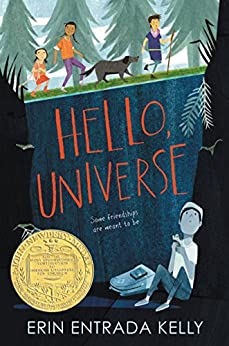
Hello Universe, Erin Entrada Kelly, 2017

Once upon a time, before every single eleven-year-old in a book seemed mandated to face off with magical creatures, wizards, ancient gods, evil governments, and/or a Chosen One Destiny, children in children’s books used to ponder cosmic questions while dealing with neighborhood bullies. Or obnoxious siblings. Or parents who gave them embarrassing nicknames. Hello Universe manages to be a novel in that classic mold, while also allowing its young heroes to ask questions about Life, the Universe, and Fate.

I came to this book already a big fan of Erin Entrada Kelly’s spectacular fantasy Lalani of the Distant Sea, which I will get around to reviewing here one of these days. (It’s SO GOOD, you guys. One of the most beautifully written middle grade fantasies I’ve ever read.) I was curious to see how Kelly writes realistic fiction. Answer: brilliantly.

the story

Hello Universe shifts points of view between four young characters. Valencia: brilliant, dealing with hearing impairment, strong-willed, and secretly lonely. Virgil: shy, awkward, outwardly lonely, best friends with his grandmother and his pet guinea pig. Kaori: confident, compassionate, a self-proclaimed mystic. Chet: an insecure bully whom you’ll want to punch in the face. All four children live in the same neighborhood. Virgil is friends with Kaori (so far he’s the only “client” for the physic business she runs out of her bedroom), he’s one of Chet’s favorite targets for bullying, and he secretly wishes he could be friends with (or maybe even middle-school date?) Valencia. Unfortunately, he’s too shy to approach Valencia.

[FROM HERE THERE BE SPOILERS. YE HAVE BEEN WARNED.]

Valencia decides to contact Kaori for dream advice after a series of recurring nightmares. On a the same day as her psychic appointment, when Virgil is heading toward Kaori’s house for his own appointment, he runs into Chet on the way. Chet, never one to resist a chance to bully Virgil, steals Virgil’s backpack and throws it down an old well — not knowing that Virgil’s beloved guinea pig, Gulliver, is in the backpack. (I hate Chet. Kelly does a great job humanizing him, and I still hate him.) From here, the story takes off: Virgil climbs down into the well to rescue his guinea pig, Valencia unknowingly traps him in the well on her way to Kaori’s house, and the rest of the novel is a race against time as Kaori, Valencia, and Kaori’s little sister Gen try to find Virgil before he runs out of oxygen and hope. Needless to say, Virgil and Valencia finally meet. AND GULLIVER IS OKAY WHICH IS WHAT REALLY MATTERS.

the babble

Just like Lalani, this book is gorgeously written – and much funnier than its immediate predecessor. These kids feel so REAL. This is a neighborhood story, set in a diverse neighborhood that feels lived-in. Kelly creates four (I would argue five, including Gen) distinct character voices, in writing that ranges from irreverent texting exchanges to poetic musings about mythical creatures of darkness.

Valencia and Virgil are well-sketched characters in the traditional middle grade fiction mode: lonely, misunderstood, far from the top of the social food chain at school, and trying to hide their suffering and angst from their respective families. I’m not the right person to pass informed judgement on such things, but it seemed to me that Valencia’s hearing impairment was treated with detailed sensitivity, and it didn’t solely define her character. Kelly establishes these two characters’ similarities enough to create the sense of fate pulling them together as potential friends, while also making them fully distinct as individuals.

It’s the other two characters who really caught my fancy. First, Chet. Like I said, I hate him — but I do sympathize with him a little bit, which means that Kelly has done her job effectively. Not many authors for this age group attempt to write from the bully’s point of view. Chet plays an integral part in this story, and rather than leave him as the common boogeyman, as most children’s novels might, Hello Universe tells at least part of the story looking at the world through Chet’s eyes. I actually wish we had gotten another chapter or two from Chet.

But now let’s talk about Kaori, because I’ve been waiting this whole blog post to talk about Kaori.

Kaori Tanaka might be one of my favorite middle grade characters of all time, and I would gladly read an entire book just about her relationship with Gen, who is also fantastic. Kelly has created such a confident point of view for this character: Kaori is the rare twelve-year-old who knows exactly who she is, feels comfortable in her skin, and can reach out to others in a sensitive way. Every single Kaori chapter is a priceless, often hilarious internal monologue. But – and this is important – Kelly never makes fun of Kaori. She celebrates her confidence and her interests. Maybe it’s Kelly’s prowess as a writer, maybe it’s because I was also obsessed with occult and psychic stuff when I was in middle school, but I adored Kaori and her pesky assistant sister from the start. I could use some advice from her “spirit room” myself, but alas, “NO ADULTS” allowed.

Basically, this novel has everything: it will make you laugh, it will make you cry, it will make you incredibly nervous for poor Virgil even as you realize this is a children’s book so of course he’s probably going to be fine. Highly recommend.

rating

**** out of 4

RANDOM BABBLE

  • Like most bullies with backstory, Chet seems to have daddy issues. But I appreciate that Kelly paints the father as a powerful business man, someone who enjoys using his privilege to punch down then invites Chet in on the joke. We get to see Chet grapple with his discomfort in these situations, while imitating it later.
  • I love the various characters’ personal treasures — Kaori’s spirit stones, Valenica’s wildlife journal, Gen’s jump rope.
  • Kelly uses third person past tense for chapters from Virgil’s, Kaori’s, and Chet’s points of view, while using first person present tense for Valencia chapters. That’s so fascinating. I have some guesses why, but haven’t fully puzzled it out yet. What do you think?

THE GLASS HOTEL Review: Or, My Undying Love for Emily St. John Mandel, Part 2

Olivia closed the door behind her and stood for a moment in silence. She set her keys on the kitchen table and sat for a while, trying to adjust to the world at hand.

The Glass Hotel, Emily St. John Mandel, 2020

Emily St. John Mandel excels at creating puzzles out of human stories. She likes to assemble a portrait of multiple human lives meshed perfectly together, break that portrait up into jagged but intersecting pieces, and then scatter those pieces across the table. In The Glass Hotel, as in Station Eleven, the puzzle pieces only reassemble into that portrait again in the novel’s final few pages.

I dove right into The Glass Hotel immediately after rereading Station Eleven for the fourth time. While Mandel’s newest work is a fantastic read and I promise to talk about it in its own right, the two make for a fascinating comparison.

THE STORY

The puzzle of The Glass Hotel follows two major story arcs: the troubled relationship between half-siblings Vincent and Paul, and the downfall of Jonathan Alkaitis, a wealthy man who runs a successful pyramid scheme. The two arcs intersect through Vincent, who eventually becomes Jonathan’s second wife (well, not technically his wife, but wife for all intents and purposes). Like Station Eleven, this book hops back and forth through time, examining the ever-widening circle of people whom Alkaitis and Vincent impact.

Paul and Vincent have never been close: Paul’s father left his family for Vincent’s mother, and Paul failed to act as a steadying hand for Vincent when her mother tragically drowned. Paul has struggled with heroin addiction since his mid-teens, and the novel traces the ups and downs of that lifelong struggle. Vincent, meanwhile, has felt self-reliant but also somewhat untethered since her mother’s death. Alkaitis meets her while she’s on shift as a bartender for the Hotel Caiette (which he owns), a shimmering hotel with large glass windows located in a remote part of Vancouver Island.

The novel traces the kaleidoscope of people impacted by the Hotel Caiette’s existence, by Paul’s existence, by Vincent’s existence, and above all by Alkaitis’ pyramid scheme and its eventual collapse.

THE BABBLE

Give me quiet, he thought, give me forests and ocean and no roads. Give me the walk to the village through the woods in summer, give me the sound of wind in cedar branches, give me mist rising over the water, give me the view of green branches from my bathtub in the mornings. Give me a place with no people in it, because I will never fully trust another person again.

The Glass Hotel, Emily St. John Mandel, 2020

What a difference six years can make.

While Station Eleven contains a thread of optimism about human culture and persistence (and that’s what I love about it), The Glass Hotel feels so much bleaker. (Which, I mean, I’m assuming Mandel wrote this one mostly during 2017 through 2019 and it was released in March 2020, so…understandable perspective shift, yeah?)

[FROM HERE THERE BE SPOILERS. YE HAVE BEEN WARNED.]

Much like the real world at large, you’ll find little sense of justice in this novel. Vincent dies, y’all. She dies on the first few pages, so that’s not much of a spoiler, but she also dies tragically and ultimately without fanfare. The investigation into her death is closed and covered up. Similarly, Alkaitis goes to prison without much of a fuss, once his pyramid scheme unravels, but that fact provides precious little relief for his victims. Mandel doesn’t shy away from showing us the impact that a successful 21st-century con artist can have on people from all walks of life, and all financial levels. In the end, Jonathan keeps most of the blame, but it’s clear that his numbers never added up, and to a certain extent his victims fell prey to his pitch because they wanted a way to make easy money.

The novel’s explorations of wealth provide one of many fascinating comparisons to Station Eleven. When you boil them down, both novels follow the individual lives that ripple out from an aging wealthy man: Arthur Leander in Station Eleven, Jonathan Alkaitis here. (Even more specifically, you could argue that both novels have two primary protagonists, an older wealthy man and a younger woman with whom his life intersects; Kirsten would be Vincent’s parallel in Station Eleven.) Yet while Arthur Leander certainly has his flaws, Alkaitis has him beat in the slimy human department by a long mile. In Station Eleven, flashbacks into the world of the rich and famous have a sheen of glamor to them, even when we’re meeting rich people who act obnoxious or insensitive. The world of New York finance painted in Glass Hotel, while just as rich and just as fancy, lacks that luster.

Mandel digs into the question of what makes people steal from fellow human beings: steal their money, steal their art, steal their hope. For Jonathan, it seems to be a fascination with his own ability to charm others. For those who work for him, who knowingly set up the ruin of thousands of lives, the answer is simple: it’s about taking home a healthy paycheck. So many of the bad decisions in this book stem from financial insecurity. Even poor Paul, who can often feel tangential to the larger story, steals Vincent’s video work as a way to build his artistic career. Vincent’s death is covered up because the investigator lost his entire life savings so that Alkaitis could get richer, and he needs more investigation contracts to help support both himself and his wife after a forced retirement. Because this is a contract economy, of course, those hoped-for contracts never appear. Like I said…bleak. This story left me sympathizing with Walter, the eventual caretaker of the eponymous glass hotel in the wilderness. The ultimate feeling is less, “Ah yes, thank goodness, humanity will preserve art and civilization and the best of itself even to the end of the world,” and more along the lines of:

All in all, Station Eleven is the novel that 2020 needs, but The Glass Hotel might be the novel 2020 deserves.

rating

***1/2 out of 4

random babble

  • Love love LOVE the easter eggs for Station Eleven readers, the way we gradually learn that this is an alternate universe version of the world from the previous novel. Miranda is alive, you guys! She gets to be so successful and takes over Neptune shipping company and I was so happy! Vincent also has that great moment where she idly wonders what might have happened if that Georgian Flu hadn’t been so effectively contained. (Keep in mind, the novel asking this question came out the first week of March, 2o20. Cue Twilight Zone music.)
  • My main complaint about this book is small, but I think it’s legit: I wish we could have had one or two more scenes with Vincent and Geoffrey to establish their relationship. Plotwise, I understand why Mandel didn’t give any to us, because she clearly wanted to set up suspense around Geoffrey as Vincent’s potential murderer. But by the end of the novel, I found I cared less about the mystery of Vincent’s death and more about this one true meaningful relationship that she finally found, so close to the end of her life. I would have traded some mystery to see more of that. I feel like Mandel had to rely on telling us it was meaningful at the end, rather than showing us.
  • I love the Office Chorus section. I can’t remember another time I’ve read something in a plural first person voice, weaving in and out with omniscient narration. It’s a delicate balancing act, but Mandel pulls it off and the effect is SO COOL.
  • As always, Mandel somehow manages to mix deeply human characterization with gorgeous, poetic prose, especially in the descriptions of Caiette. It doesn’t exist (I checked) but I still want to stay at that friggin’ hotel.
  • Honestly, Vancouver Island has never been at the top of my travel list. But after this recent Mandel dive, it now is. If travel ever becomes a thing we can do again.

Back to books for children and young adults next time! Stay safe, stay healthy, happy reading, and remember:

STATION ELEVEN Review: Or, My Undying Love for Emily St. John Mandel, Part 1

All three caravans of the Traveling Symphony are labeled as such, THE TRAVELING SYMPHONY lettered in white on both sides, but the lead caravan carries an additional line of text: “Because survival is insufficient.”

Station Eleven, Emily St. John Mandel, 2014

This novel is perfect. I won’t say that about books too often on this blog [hopefully, at least, because otherwise what’s the point?] but I will confidently say it about Station Eleven. This book has only been out for six years and it has already risen through the ranks to join my all-time reread favorites.

As news of the COVID-19 pandemic started growing to a fevered pitch, and especially once the Shelter in Place order came down for my city, I knew exactly which book I needed to read. Not wanted. Needed.

Unfortunately, I couldn’t drop everything and read it just then, because I had lots of books waiting in line to read for my job and for grad school homework. So there the novel remained, staring at me from the bookshelf, like a hug waiting to happen. When I finally sat down on my couch to begin reading about Arthur Leander’s fateful performance of King Lear, it felt like taking a deep breath for the first time in a while. Nothing about the real world pandemic had actually changed, but reading this book made me feel that, somehow, everything was at least a little bit okay.

the story

Aging Hollywood star Arthur Leander collapses onstage from a heart attack while performing the title role of King Lear at a Toronto theater. No one in the theater knows it yet, but that same night a deadly virus called the Georgian Flu is sweeping across North America (and the globe) and overwhelming the healthcare infrastructure in every country. Within weeks, much of the world’s population will be wiped out.

[FROM HERE THERE BE SPOILERS. YE HAVE BEEN WARNED.]

The rest of the novel jumps back and forth through time, following multiple characters whose lives intersect with Arthur’s. Many of these characters survive the virus and the collapse of civilization as we know it: Kirsten, a child actress from the production of King Lear; Jeevan, the paramedic-in-training who jumps on stage, trying to save Arthur’s life; Clark, his best friend; Elizabeth, his second wife, and her son, Tyler. Others aren’t so lucky — most notably Miranda, Arthur’s first wife and the artist behind the Station Eleven comics that give the novel its name. We jump decades before the collapse of civilization, tracing Arthur’s life and the creation of those Station Eleven comics, and twenty years after, when small settlements have begun to pop up across the landscape. Kirsten now spends her life as part of The Traveling Symphony, a troupe that spends year after year on the road cycling between settlements, performing both classical music and Shakespeare plays. Clark has begun a Museum of Human Civilization in the airport where he’s made his new home. Jeevan is a doctor in the Southern U.S. — or what passes for a doctor in the new world. And Kyle has become something more sinister. (I won’t say what. I don’t want to spoil everything for you.) Many of these characters will meet again by the novel’s end, after a story tracing the enduring impact of art on human life throughout the decades.

The babble

So why did I feel such an insistent need to read this novel when it became clear that COVID-19 wasn’t just another overblown news story? If you know me well, then the initial answer is pretty obvious. Not only am I an actress and a musician, but I’m also a Shakespearean actress and scholar, so the idea of The Travelling Symphony speaks to my soul. If I ever beat the statistical odds and find myself still alive in a post-apocalyptic world, you can bet I’ll try to be like Kirsten, travelling from town to town and speaking some Titania lines in return for food and shelter.

But there are plenty of other reasons to love this novel. Let me count the ways:

  1. Mandel doesn’t spend time on the immediate aftermath of civilization’s collapse. I’ve read a few reviews that complained about this choice, but I think it’s a feature rather than a bug. I sell YA novels and I also like to read them, and we as a culture also like dystopian movies, so I’ve read and seen so many modern visions of dystopia that I’ve lost count. They all start to feel the same after a while: the surviving humans are nearly always varying degrees of violent and shitty according to age-appropriateness and intended audience, with the exception of Our Intrepid Hero/ine(s). That isn’t the story that Mandel wants to tell here. While various characters mention in passing the violence and survivalism that plagued the first decade or so following the Collapse, Mandel holds the same Star Trek-inspired motto as the Symphony: survival is insufficient. After we lose ourselves temporarily in the fight to survive, what can make us feel human again? Mandel’s answer: the arts. Poetry. Music. Comic Books. Even magazines and photographs. Our collected stories, and the memories of a lost world.
  2. The character development. Oh, the character development. I love each of these characters so deeply, flaws and all. Mandel makes sure that you get to take your time with these people. While there are a few action-packed sequences in the book, this is mostly a character study (much like life, as it turns out).
  3. How fully fleshed out the newly settled world feels–without the mechanics taking over the story. Repurposed buildings, like Clark’s airport, or the Walmart on the edge of town (because aren’t Walmarts always on the edge of town?) where the Prophet and his crew set up shop. The caravan wagons made from the truck beds of old pickups which, of course, no longer run. I love me some Mad Max movies, but these caravans sound like a much more plausible post-apocalyptic use of pickup trucks.
  4. The depiction of Kirsten’s trauma processing. The fact that she can’t remember her parents’ faces, or much of the first few years following the Collapse, is desperately sad but it also rings true.
  5. Luli. Let’s not forget Luli. My next pet will be named Luli, regardless of animal type.

And that’s just to name a few. I could go on and on about this book…and I have, to those unfortunate enough to show even the slightest interest. (They soon regret this decision, and begin backing away slowly in response to my emphatic hand gestures and belligerent excitement.) If I have one tiny complaint, it’s that Jeevan’s “after” story — his life following the collapse — feels a little underdeveloped compared to our other survivors. We do, however, get to spend the most time with him during the Collapse itself, so I guess it evens out.

And who am I kidding? I have no complaints. I love this book so much. I think you will, too. It’s the perfect novel to read while social distancing.

rating

**** out of 4

Random babble

  • Like I said, we don’t dwell on the violence of the collapse, but I love the detailed glimpses Mandel drops for us, such as the knife tattoo system.
  • Has anyone else read this since Shelter in Place orders came out? Damn, that Jeevan grocery shopping scene in the beginning hits close to home like never before, huh?
  • I’ve read this book four times now, and I’m still fascinated by the places where Mandel chooses to switch in and out of present vs. past tense.
  • Miranda’s death is so, so beautifully written. Makes me cry every time.
  • GEEK ALERT: Last time I was in grad school, some folks in my program were researching the perceived “cultural value” of Shakespeare: the history of his enduring legacy as a literary and theatre icon. I’m fascinated by the moment when Kirsten reflects on her fellow Symphony member who pushed the troupe to perform more contemporary work, only to find that audiences only ever requested Shakespeare. It’s an interesting point to ponder from the perspective of cultural value and the imperialist history that goes with any notion of cultural value (especially right at this moment. Ahem.) For my money, I suspect that the fictional audience wants to hear Shakespeare not because they want “high culture” — though that probably factors in unconsciously — but because Shakespeare’s plays are an auditory experience. His plays make a perfect pairing with music, because poetry is music written with words. And yes, yours truly does love a book that tells her that the things she values could potentially still have value on the other side of civilization’s end.

Thank you for coming to my TED Talk on how much I love Emily St. John Mandel. Believe it or not, this was only Part 1 of 2. Tomorrow I’ll be back with her brand new novel, The Glass Hotel!

THE HOUSE IN THE CERULEAN SEA Review: The Perfect “Summer Read” for a Summer that Involves June 2020

Don’t you wish you were here?

The House in the Cerulean Sea, T.J. Klune, 2020

Yes. Yes, I do wish I was there, you lovely, sweet book.

But in some ways, I do feel like I’m there already. Because this book deals sensitively with systemic, government-sanctioned oppression and prejudice. It also deals with finding the courage to stand up to said oppression and prejudice, not as a hotheaded and hormone-driven teenager but rather as a kindhearted but unremarkable midlevel bureaucrat. How to turn the system against itself. That might, you know, possibly have more relevance to the current cultural moment than T.J. Klune ever dreamed when he wrote it not long ago.

This isn’t a dystopian novel or an Issue novel, though. Quite the opposite. It’s a romantic comedy and character study, a lovely piece of contemporary fantasy. If you’re like me and adore Good Omens, or grew up loving the Hitchhiker’s Guide to the Galaxy series (but in your old age find the latter a bit too much, if you’re being honest), then reading this book will feel like settling into a wonderfully comfy chair from your past that you’d forgotten you missed.

THE STORY

Linus Baker lives in a version of our world that looks very much like our own, except that magical beings and creatures exist. He’s a caseworker for the Department in Charge of Magical Youth, just one agency in a giant government arm dedicated to registering, isolating, and keeping tabs on magical beings. Linus isn’t a bad person. He genuinely cares about the magical children in the “orphanages” (read: homes, as it’s pointed out that none of the children are actually up for adoption) that he inspects for work. He just happens to be a cog in a system so large that he can’t get a birds-eye view, and has to trust that the work he does truly helps these children in the long run. (Spoiler alert: it doesn’t.) He is a good-natured, Arthur Dentish-type fellow who lives a quiet, lonely life with a cat for company.

[FROM HERE THERE BE SPOILERS. YE HAVE BEEN WARNED.]

Without warning he receives a special assignment from Extremely Upper Management to investigate a mysterious, isolated home for magical youth. He will leave for a month, effective immediately. When he arrives at the foreboding house on a magic-drenched island, he meets the home’s child tenants: a young Antichrist, a female Gnome, a powerful forest sprite, a wyvern who speaks in a series of squeaks, and a werewolf who transforms into a Pomeranian. He also meets Arthur Parnassus, the master of the “orphanage,” with whom he slowly falls in love and begins a tentative relationship. Over a course of his monthlong stay, the island’s inhabitants welcome him into their home and prove to him that he knows exactly how to make a difference.

“I can have spiders in my head as long as I don’t let them consume me and destroy the world as we know it.”

The House in the Cerulean Sea, T.J. Klune

the babble

Folks, I loved this book. I loved it so much. I think it would be truly difficult to not love this book.

The humor remains light and never falters. The children are undeniably cutesy, but each has his or her own distinct personality. The whole thing has an air of myth or fable about it. It would make a great movie. (But I hope no one actually tries to make it into a movie, because this is one of those stories that would be so, so easy to ruin in the wrong filmmaker’s hands. It’s all about tone.) Linus’ gradual awakening of the soul is a delicate wonder to behold and to experience secondhand.

It is a perfect book? Not quite. Does the uplifting resolution in the last few chapters feel a bit pat? Yes. Did I catch myself thinking more than once about South Park‘s opinions regarding Nice Little Heartfelt Speeches? You betcha. (Linus gives a LOT of Nice Little Heartfelt Speeches toward the end. But in Klune’s defense, they’re pretty good speeches.) Do I care about these quibbles at all? Not really.

The experience of reading this novel feels a lot like Linus’ experience of finding himself on a lovely, magical island. I really, really needed this book right now. You might need it, too.

RATING

***1/2 out of 4

random babble

  • Apparently Klune is American. He must love all the same British authors that I love, then, because he has that distinctly British, dry-humor narrative voice thing down. It’s flawless. Feels like reading Adams, or Pratchett, or Gaiman.
  • The city where Linus lives and works is never identified as London, nor are any country names ever mentioned, but I think it’s safe to assume that this world is set up as an England parallel?
  • One of the best things about this book is that Linus is gay, but it’s not a big deal. It’s just another fact about him. When he and Arthur begin a relationship, the fact that Arthur is another man is a non-issue. Even Linus’ otherwise horrible and nosy neighbor is fine with his sexual orientation. It’s so lovely. We need more books like this.
  • Calliope is a great cat. Cats in British books (or American books masquerading in British style) are the best book cats.

THE PARKER INHERITANCE Review: It’s Time to Retire HUCK FINN

I grew up in the Deep South, about a ten minute drive from the North Carolina/South Carolina border. I later lived in Atlanta for almost ten years. I know the places in this novel. My childhood home sits on the state highway mentioned in Chapter 26.

And holy shit, I really, REALLY wish this novel had been part of the Language Arts curriculum when I was in middle school. I’m pretty sure no middle grade novels quite like this existed in the 90’s.

I’d planned to write my first book post through the lens of the COVID-19 pandemic, but in the time it’s taken me to sit down and write again, a terrifying deadly virus sweeping the globe has stopped dominating current event headlines. So in light of the long-overdue revolution happening across America (and the globe), and because I just finished The Parker Inheritance by Varian Johnson before reading it for a storytime, I’ll write about this one first instead.

Mostly, what I want to write is this: READ THIS BOOK. JUST READ IT, NO MATTER YOUR AGE. Go buy it (preferably from an indie bookstore, even more preferably from a black-owned indie bookstore) and read it right now. If you’re looking for new middle grade fiction by authors of color, featuring fantastic lead characters of color, I can’t think of a better place to start.

The story

Twelve-year old Candice Miller is not at all pleased to be living with her mother in her late grandmother’s house for the summer, stuck in a small town in South Carolina called Lambert. She misses her friends, her house, and her father, all of them back in Atlanta. Things start to look up a little, however, when she befriends Brandon–the shy boy across the street who devours library books as quickly as she does–and when she stumbles across a letter in the attic addressed to her grandmother. The letter is a challenge and a quest: full of puzzles and riddles about Lambert’s racist history. The person who solves the puzzles will earn the town of Lambert millions of dollars from a mysterious benefactor. It turns out that Candice’s grandmother, Abigail, the first black City Manager of Lambert, ruined her career by trying to solve the puzzle ten years before and was forced to leave town in disgrace.

From here the story takes off: Candice and Brandon work feverishly to solve the puzzle, trying to find the money and clear Abigail’s name. Hopping through the decades and told from multiple character perspectives, the novel slowly unfolds a story about racist oppression and violence in this small Southern town, and the ways that racism continues to threaten people of color in Lambert in the current day.

the babble

Varian Johnson has pulled off a marvel with this book. The publisher recommends The Parker Inheritance for ages 8-12, and while some eight year olds might struggle with the acts of the racist Lambert citizens detailed in flashbacks, the book feels age-appropriate to me.

[FROM HERE THERE BE SPOILERS. YE HAVE BEEN WARNED.]

Yet Johnson doesn’t pull any punches or sugar coat his topic: his novel tackles the ugliness and violence and mania of white supremacy head on, especially in the harrowing account of Lambert’s infamous 1957 tennis game and its violent aftermath. Readers will be terrified for Reggie and Big Dub and Siobhan — and they should be. What I love is that the novel doesn’t paint racism as a comfortably cut-and-dry topic, dividing the world into white supremacists of the 1950’s and everybody else. Chip, trying to be a progressive ally in the 1950’s, screws up big time and makes life harder for the very people he’s trying to help. (Oh, Chip. More on him below.) The high school vice principal adopts a racist attitude when he suspects and verbally attacks Candice and Brandon, simply for existing on school property after hours. Brandon’s older sister drives extra slowly because she is terrified of giving a cop any excuse to pull her over. The book points out that Lambert still has a very clear line between the black and white neighborhoods in town. The Parker Inheritance even addresses intraracial prejudice through the arcs for Reggie, Big Dub, and Adam Douglas.

And all this makes it sound like I’m describing a super dour novel, or an “issue” novel, but I’m not! It is sad and horrifying and suspenseful, but it is also fun, and funny, and immensely hopeful. We get to hang out with Candice and Brandon at the library while they talk about books. We get to watch Candice and Brandon counter homophobia with acceptance. We get to see these two amazing protagonists triumph. We get to solve the puzzle along with them. And — most unusually for a middle grade book full of suspense — we also grow to care for the adults in the protagonists’ world as well.

Literary legacy is a funny thing. The only book I remember reading during my K-12 years that addressed racism head-on was that stalwart classic, The Adventures of Huckleberry Finn. Which, don’t get me wrong, is an excellent book. It’s a classic for a reason. And it’s also the subject of plenty of controversy these days when used as a classroom title.

I don’t believe in censoring books, or removing them from the public sphere. If you want your kid to read Huck Finn, go for it. Buy it or check it out from your local library. But great as it is, that novel about racism was written by a [brilliant] white guy in 1886. For so long, we didn’t have many other options.

The Parker Inheritance was written NOW, by an immensely talented author of color, and it doesn’t banish American racism to a comfortable past. It talks about slavery AND racism in the 1950’s AND racism now. It also talks about kids who love to read, and what it feels like to be a middle schooler navigating bullies and the social structure, and what it feels like to have your parents go through a divorce, and what it feels like to miss your beloved dead grandparent, and what it feels like to find a clever solution that the adults around you missed. It is beautifully and cleverly written, it is fun and unflinching at the same time. It will be an education for just about any middle schooler (or high schooler, honestly) who reads it.

Basically, there’s no real need to teach Huck Finn anymore, when we can teach books like The Parker Inheritance instead. In this case, it might be time to retire the classic and work on establishing a new classic.

rating

**** out of 4

random babble

  • Oh man, Chip’s mistake with Reggie and the Cokes is SO UNCOMFORTABLE, folks. I cringed so hard I dropped the book. And that’s exactly how I should feel. That’s exactly the type of discomfort this book makes people like me sit with. Allies screw up, too. All the time.
  • Honestly, I love the way that Chip’s arc is handled. He doesn’t get the girl. He accepts that. He helps the way he is needed. He may be clueless, but when everything is on the line, he does the work. And it sounds like he keeps doing the work for the rest of his life.
  • I love the way that Reggie’s arc plays out as well, mostly. Definitely didn’t see that big twist coming. And I love that Siobhan calls him out on his shit when he finds her again. I’m not sure how I feel about how forgiving she is toward Lambert, but then again, I’m not the right person to pass any sort of judgement on that arc.
  • Good lord, this book just packs in SO MUCH, all of it deftly handled. The many facets of racism. Bullying. Divorce. Coming out. Grief. And did I mention it also manages to be fun and enjoyable?
  • For younger readers in that 8-12 category: don’t be fooled by Scholastic’s printing. They’ve tried to disguise how dense this book is by making it look the normal size as other middle grade novels, but I noticed that the font size and the line spacing are both smaller than usual.

Oh, and in case I didn’t make it clear how I feel about the topic:

My Mom Made Me Do It: Our Heroine Starts a Blog

woman writing pierre bonnard

A word after a word

After a word is power.

Margaret Atwood, “Spelling”

May 26, 2020

On a dark and stormy night in a crumbling world, I stumbled upon a forgotten blog post dated nearly one year in the past.

(It wasn’t stormy, actually – I think I’ve heard thunder in California precisely twice. But it was dark, and the world was indeed crumbling, which explained the glass of wine I was drinking, which explained why I was thinking seriously about starting a blog, before remembering I had already started a blog some time ago.)

The words stared accusingly from the laptop screen, promising that they weren’t mad at me, just disappointed. Words that were written in a house nearly 3,000 miles away, in what feels like another life. I leave them here for your perusal.

August 11, 2019

My mother is sick.

She’s the kind of sick where you don’t want to deny any request to the person in question. The kind of sick where, when she says she misses the days when you used to write new stuff all the time, and shouldn’t you really start a blog of your own, and how happy it would make her if you did, you say yes. Even though the thought makes you seize up inside, you start a damn blog.

But don’t worry — this isn’t going to be one of those “my mom has Stage 4 cancer and I’m going to write about that a lot because aren’t I so deep now” blogs.

I used to write all sorts of things: songs, plays, stories dreamt in great detail then hastily abandoned, terrible (and I do mean TERRIBLE) poetry. Then I stopped. Maybe it’s time to try again. Let’s see what happens.

May 26, 2020

And there you have it, dear reader. A ghost version of myself, speaking from the past. What happened, of course, is absolutely nothing, and that should give you some indication of my ability to follow through on personal projects.

My mother is still sick, but not AS sick. And she is still, thank everything holy, very much alive. And she is still bugging me to start a blog so that she can read my writing from the other side of the country, now that I’m no longer her live-in nurse.

The rest of the world is also sick. Not just metaphorically sick, but dying from a crafty new virus that scientists are scrambling to understand and Americans seem determined to ignore. The loss and terror are overwhelming, and I can’t do much to change that. But I can try to keep my promise to my mother.

Since writing those words, I have fulfilled a lifelong dream by landing a job at a children’s bookstore, begun graduate study to become a librarian, and read lots and lots and lots of books. I hope to write my thoughts about those books (and anything else that happens to lodge in my brain) here. I hope that the three or so people reading this blog will enjoy said thoughts.

Let’s dive in.